
Conservation and Amendment 3, Sebastian Pines, and more

November 14, 2026 Weekly Newsletter

Conservation After Amendment 3: Lessons From Our Neighbors
While Florida was approving Amendment 3 last Tuesday, voters in three Central Florida counties were also deciding how to protect land and water. Their results offer an early look at what conservation funding looks like now, and some ideas worth borrowing.
Marion County voters overwhelmingly approved up to $140 million in bonds for parks, farmland and springs. It’s backed by a property tax of 0.34 mills, about $35 per $100,000 of taxable value. But the county’s parks director warned before the election that Amendment 3 will “significantly” reduce Marion’s ability to borrow the full $140 million. That slows the program and limits what it can buy. He also said Amendment 3 will cut Marion’s parks budget by nearly half, eliminating more than 25 positions and closing or outsourcing 22 of its 55 parks.
That’s the squeeze. Conservation bonds are paid back with property taxes. Shrink the property tax base, and the same voter-approved tax rate buys less land. Any future conservation bond in Indian River County will face the same math.
Brevard County took a different route. Voters overwhelmingly renewed the Save Our Indian River Lagoon half-cent sales tax for another ten years. A sales tax isn’t tied to property values, and part of it is paid by visitors. Brevard’s lagoon program has paid for septic upgrades, muck removal and stormwater projects. Its renewal shows voters will fund clean water when they can see results.
Volusia County narrowly approved a charter amendment that creates a registry of conservation lands. Land on the registry can’t be sold or transferred without a supermajority vote of the county council. It doesn’t cost a dime, but it makes it much harder to sell off preserved land when budgets get tight. Some residents worry that an exemption for “public purpose” uses could become a loophole, which is why the details matter.
What it means here: Indian River County is weighing land purchases right now, including the effort to protect 800 acres near Blue Cypress Lake. Every dollar of conservation money just became more valuable, and conserved land may face new growth pressure as the county looks for savings.
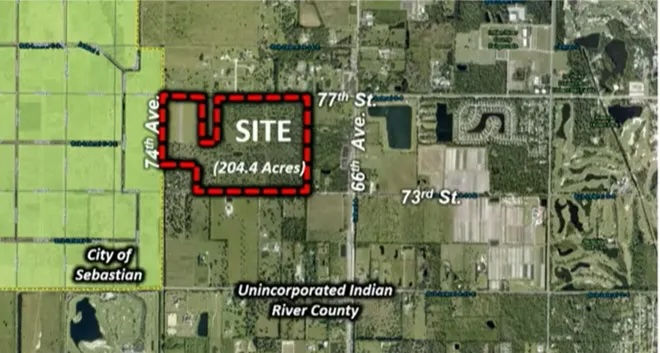
502 Homes on Old Citrus Land: Sebastian Pines Goes to P&Z Nov 19
The 204-acre Sebastian Pines development is back before Sebastian’s Planning & Zoning Commission on Thursday, November 19 at 6 PM. This time it’s for the preliminary plat. Sebastian annexed the former orange grove (between 73rd and 77th Streets, from 66th to 74th Avenue) in May. City Council then approved its land use and PUD zoning unanimously in September. Developer Concordia Group plans 502 homes.
So why does a plat hearing matter? Earlier votes settled how many homes. The plat stage settles how the site is actually built: where the lots go, how big and deep the ponds are, and how stormwater leaves the property. During the zoning hearings, the city and developer said detailed drainage design would come later. Later is now.
That matters more after November 2, when more than 13 inches of rain fell along I-95 in Indian River County. This land is flat and low, and the developer’s own soil borings put the wet-season water table just 1 to 1.5 feet below the surface. The plan relies on lakes that store stormwater on site and release it into canals managed by the Indian River Farms Water Control District.
There’s also a groundwater question. A neighbor on 73rd Street who depends on a private well has written to the St. Johns River Water Management District with concerns. He says developer representatives told residents the ponds would be dug 20 to 25 feet deep, in part to supply fill to raise house pads. Old groves can carry arsenic and other residues from decades of pesticide use, bound up in the topsoil. His worry is that deep digging could cut through a natural hardpan layer a few feet down, opening a path for those residues to reach the shallow aquifer that nearby wells draw from. The county’s Hobart wellfield is also close by.
The developer’s stormwater report, filed with the District on November 5 (Permit #91036-6), answers some of this. The ponds would cover about 48 acres, and the report’s storage calculations run them down to about 19 feet below today’s average ground level. The site’s soils consultant expects fill for the house pads to come “from the stormwater areas first.” The ponds would hold more than 11 times the permanent water the District requires, with an average depth of 16.6 feet, even though the report’s own checklist calls for 2 to 8 feet. The report doesn’t mention the hardpan, liners, testing for grove chemicals, or neighboring wells. The system is designed for 12 inches of rain in 24 hours, less than what fell along I-95 on November 2.
We haven’t seen the plat drawings yet, and we’re not prejudging them. But these are fair questions for a public hearing:
Has the site been tested for arsenic and other grove chemicals? The stormwater and soils reports don’t say.
Why do the ponds need an average depth of 16 feet when the report’s own guideline is 2 to 8? Will they cut through the hardpan, and if so, will they be lined?
Will soil dug from the ponds be tested before it’s used as fill under homes?
Will anyone monitor neighboring wells before and after construction?
The system is designed for 12 inches of rain in 24 hours. What happens when a storm like November 2 brings more?
What you can do: The preliminary plat is available for public review at Sebastian’s Community Development Department at City Hall, 1225 Main Street (weekdays 8 AM to 4:30 PM). The stormwater report is online at permitting.sjrwmd.com (search for permit 91036-6). Take a look, then come speak at the November 19 meeting in City Council Chambers. No court reporter will record the meeting, so if you have concerns, raise them at the hearing, where they become part of the public record. If you live nearby on a private well, this is your best chance to get answers on the record. P&Z will make a recommendation, and City Council will make the final decision.

Sebastian lagoon oxygen holds at dawn; salinity crash stresses shellfish, caution south of Vero Beach (Sebastian Daily) - Dissolved oxygen in the Indian River Lagoon at Sebastian stayed safe for fish, but salinity there crashed from 27.5 to 7.1 PSU, stressing oysters, clams and seagrass, while oxygen at Link Port south of Vero Beach fell below the danger line.
Vero Beach candidate neared history. St Lucie races in focus (TCPalm) - Laurence Reisman reflects on close Treasure Coast election results, including Vero Beach’s Dan Green narrowly trailing U.S. Rep. Darren Soto in the redrawn District 9, and worries about new, inexperienced councils in Port St. Lucie and Fellsmere.
Dormant industrial park in Vero gets new life (Hometown News) - The Indian River County Planning & Zoning Commission unanimously recommended rezoning about 1.82 acres in the long-dormant Vero West Business Park, on Enterprise Road south of State Road 60, from Commercial General to Light Industrial; staff and chamber economic development officials said the change would extend the park’s existing industrial zoning and help attract employers as a new owner revives the site with tenants like Sunbelt Rentals.
Sebastian Council approves Sembler property purchase (Hometown News) - Sebastian City Council unanimously approved a $2.5 million purchase of the 1.3-acre riverfront Sembler property, funded largely by state grants and the sale of the old Public Works compound, to preserve the city’s working waterfront and the county’s only oyster farm.
AMC closes Indian River 24 at Vero Beach mall after Nov. 8 (Sebastian Daily) - AMC closed its Indian River 24 theater at the struggling Indian River Mall after November 8, leaving the Vero Beach area without an AMC and sending moviegoers to Port St. Lucie or Melbourne.

West Oslo Overlay: What IRNA Told the County, and What Comes Next
Last week we shared a column on the West Oslo Overlay District, the county’s plan to shape growth along the Oslo Road corridor near I-95. Here’s where IRNA stands, and what happens next.
On October 26, IRNA sent the county written comments on the draft regulations. We told staff this is one of the strongest design-focused drafts we’ve seen in Florida. We especially support:
Mandatory urban-form standards that can’t be waived because of cost or corporate building prototypes
No gated streets or cul-de-sacs
Dark-sky lighting and underground utilities
A 10 percent civic open space requirement
A walkable canal path along 9th Street SW
We also asked the county to close some gaps:
Narrow the waivers. As drafted, some projects could seek waivers from the very standards the overlay calls mandatory.
Set a maximum block length. Without one, “walkable” isn’t enforceable.
Keep public review for big projects. The draft lets mixed-use projects up to 150,000 square feet get staff-only approval. We suggested 40,000 to 50,000.
Protect water quality. We asked for central sewer for mixed-use development, low-impact stormwater design, treatment before runoff reaches the canal, and Florida-Friendly and native plantings.
Put the boundary map and color lists in the ordinance, so future changes go through a public hearing.
Confirm the legal footing under recent state laws limiting local design rules, so the overlay isn’t vulnerable to challenge after it’s adopted.
On November 5, IRNA volunteers attended the county’s public workshop. The revised draft reflects several of our recommendations, including a 10 percent cap on staff-level adjustments, real building-type diversity, and review of a development as a whole rather than building by building. Staff also said clearly that existing zoning would not be lowered.
Some issues are still open, including the waiver provision and measurable design standards. We had also encouraged a full form-based code with a corridor plan that lays out streets, civic spaces and pedestrian connections in advance. That doesn’t appear to be in the budget right now, especially after Amendment 3. We understand, but we’ll keep making the case for it as a future project, possibly with help from the Treasure Coast Regional Planning Council.
What comes next: Staff plans to bring the ordinance to the Board of County Commissioners. No hearing dates are set yet. We’ll let you know as soon as they are.
The corridor between Vero Beach and the new I-95 interchange is going to develop regardless of this plan. The overlay decides whether it becomes a connected, walkable place or another stretch of strip centers and gated subdivisions. County planners have done good work here, and they deserve credit and support. When the hearings come, show up and tell commissioners you want the standards kept strong.
Florida property taxes could be eliminated with Amendment 3 (TCPalm) - Florida’s newly approved Amendment 3 raises the homestead exemption to $250,000 by 2028 and lets lawmakers raise it further without another amendment, opening the door to eliminating homestead property taxes and potentially forcing deep cuts to local government budgets.
November 2026 Peligram (Pelican Island Audubon Society) - Pelican Island Audubon’s November 2026 Peligram features board chair Richard Baker’s column arguing that trap-neuter-release doesn’t reduce feral cat populations, plus updates on a record fall bird migration, monarchs, and the January 16 Transforming Landscapes conference.
White House blocked health reform because it needed Big Sugar campaign cash (VoteWater.org) - A former adviser to RFK Jr. claims White House Chief of Staff Susie Wiles blocked “Make America Healthy Again” food reforms to protect sugar industry campaign donations, which Gil Smart argues shows how “dirty money” from Big Sugar (at least $4.3 million this cycle) warps health policy.
Martin County muzzles routine train horns with Quiet Zones (TCPalm) - Martin County commissioners voted 3-2 to create train horn quiet zones at three crossings in Jensen Beach and Hobe Sound for about $30,000, rejecting a push to cover all 27 crossings countywide at an estimated $650,000.
'All contaminated with sewage'; Jensen Beach neighborhood still underwater (TCPalm) - A Jensen Beach neighborhood on septic tanks remains flooded with sewage-contaminated water more than a week after the Treasure Coast’s historic 100- to 200-year rainfall, part of a long-running flooding problem that has left 66 Martin County homes with water intrusion and 25 destroyed.


Comments