
Florida's Un-Environmental Budget, PFAS Comments to EPA, and more!

June 13, 2026 Weekly Newsletter

Florida's 2026-27 Budget Is an Environmental Disaster
And the Legislature Knows It
The Florida Legislature just passed a $114.5 billion state budget, finalized behind closed doors over Memorial Day weekend, with the only public committee meeting held at 10:45 p.m. on the Sunday before the holiday. No members of the public were allowed to speak. And honestly? The process fits the product because what they were hiding wasn't pretty.
For the second year in a row, lawmakers failed to pass a budget during the regular 60-day session and had to return for a special session. What they produced when they finally got around to it represents, by most measures, the worst environmental budget Florida has seen since the Rick Scott era. Maybe worse.
Florida Forever: Abandoned
Let's start with the most straightforward failure and one we've mentioned before here a lot. Florida Forever, the state's flagship land conservation program, which funds the acquisition of state parks, wildlife habitat, and watershed protection lands, received zero new dollars in this budget.
Zero. Not a cut. Zero.
This is is actually kind of against a law the legislature passed previously. A 2023 state law set a minimum annual funding floor of $100 million for the program. The Legislature ignored it. And this comes on the heels of last year's $18 million appropriation, itself a fraction of what the law requires.
For context: under Jeb Bush, Florida Forever was funded at roughly $300 million a year, and since its inception the program has protected more than 2.6 million acres across the state. (And $300m in 2006 dollars is about $500m now...) Florida voters approved Amendment 1 in 2014 with 75% support specifically to fund land conservation. A Mason-Dixon poll conducted this year found that 81% of Florida voters, including 78% of Republicans, support funding Florida Forever at the $100 million minimum.
The Legislature knows this. They just don't care.
The Wildlife Corridor Money? Gone.
A few years ago, the Florida Legislature unanimously approved dedicated funding for the Florida Wildlife Corridor, a celebrated program to connect natural lands across the state. That unanimous vote was used in press releases. It was a ribbon-cutting moment.
This budget claws back every remaining dollar of that funding, roughly $387 million, and redirects the majority of it. About $225 million goes to the Department of Agriculture for agricultural conservation easements: private-land deals that technically prevent development but provide zero public access and, according to critics, questionable environmental benefit. You can't hike on an easement. You can't fish it or kayak it or take your kids to see a gopher tortoise. It's a subsidy to landowners dressed up as conservation.
There's also the matter of Okaloosa County, which keeps appearing in this budget for some strange reason. In the prior budget cycle, the state approved the purchase of roughly four acres of coastal property in Destin for $83.3 million, more than $20 million per acre, from a Louisiana real estate developer named Robert Guidry, who has donated heavily to Republican campaigns and committees. The county had appraised the land at about $10.5 million. Clay Henderson, widely credited as the architect of Florida's environmental land-buying programs, said that same $83 million "would have bought 60,000 acres of conservation easements or 25,000 acres of land sold outright." This year's budget reportedly steers more remaining Corridor funds toward Okaloosa coastal landowners, with Guidry's name surfacing again in reporting by journalist Jason Garcia.
This is what conservation funding looks like when donor relationships replace science.
Water Quality: Defunded Again
The Water Quality Improvement Grant Program was created in 2023 for a specific purpose: to ensure that water restoration money gets directed to the most effective and beneficial projects based on science. For the second year in a row, the Legislature defunded it and swept the money into pork-barrel projects that benefit local developers and political allies instead.
Springs funding was held at $50 million (the bare statutory minimum) for the twelfth year running. The Florida Springs Council says the state needs at least $150 million per year to make real progress; at $50 million, nitrogen pollution continues to rise in many springs systems, not fall.
The Indian River Lagoon, the Apalachicola River, Biscayne Bay, and the Florida Keys all received less funding than springs. For IRNA members: the IRL's 2025 economic valuation found the estuary generates $28.3 billion annually in local economic activity and supports more than 128,000 jobs across seven counties. Restoration returns an estimated $24 for every $1 invested. The Legislature's response was to cut its funding.
The Department of Environmental Protection as a whole is being cut to roughly $2.45 billion, nearly 40% below its recent peak, representing about $1.7 billion less per year for forests, wildlife corridors, springs, rivers, estuaries, water quality, and regulatory programs.
"But Wait, There's Good News" (Sort Of)
To be fair (and we try to be) the budget does include roughly $645 million for Everglades restoration, which the Everglades Foundation praised. Proponents of the agricultural easement approach will point out that easements do prevent development, even if they don't provide public access. A $2.5 million appropriation was included to explore swimming at Silver Springs (which conservation advocates actually opposed on wildlife safety grounds, so draw your own conclusions about what "good" means here).
These are not nothing. But they don't come close to offsetting a budget that abandoned Florida Forever entirely, gutted the Wildlife Corridor, defunded the water quality grant program for the second consecutive year, and cut the state's environmental agency by hundreds of millions of dollars.
What Comes Next
The budget now heads to Governor DeSantis for signature, and he does have line-item veto power, a tool he has used aggressively in prior years, cutting anywhere from $510 million to $3.1 billion in individual budget cycles. He vetoed a similar Wildlife Corridor clawback in 2025. There is some possibility he trims the worst of the donor-windfall provisions.
But here's the thing about veto power: it can cut spending. It cannot create it. A governor cannot veto his way into funding Florida Forever. He cannot line-item a new water quality grant program into existence. If the Legislature sends him a budget with zero dollars for land conservation, the best-case scenario with the pen is that some of the worst individual projects get cut. The $100 million Florida Forever appropriation the law requires? That's gone unless lawmakers put it in, and they didn't.
Florida was once a national model for environmental conservation. It doesn't have to stay on this path its on. But the 2026-27 budget is a clear statement of legislative priorities, and those priorities are not clean water, public lands, or the ecological systems that make this state worth living in.
Voters will have a chance to weigh in this November. They should remember this budget when they do.
PFAS Well Water Testing
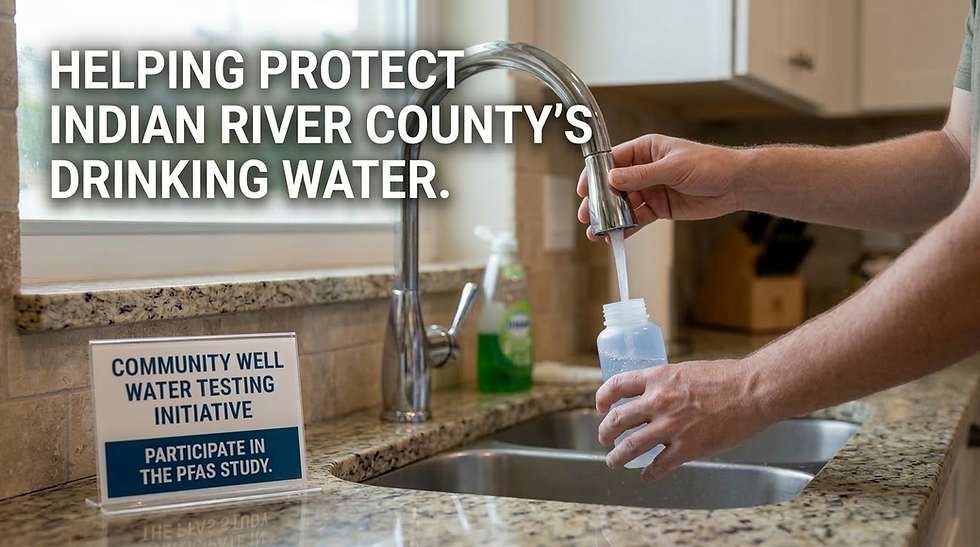
IRNA is offering free, certified lab testing for PFAS ("forever chemicals") in private drinking water wells. Sign up, submit your water sample, and get your results, plus learn what they mean for your health.
We are especially searching for wells at or near Blue Cypress Lake, Fellsmere, Gifford, and Wabasso. You are invited to a Zoom meeting.Topic:
Topic: PFAS Well Water Study
Time: Jun 16, 2026 10:00 AM Eastern Time (US and Canada)
Join Zoom Meeting
Meeting ID: 843 9200 1605
Passcode: 912768
One tap mobile
+13052241968,,84392001605#,,,,*912768# US
Open to Indian River County home and business owners on private wells only (not connected to municipal water). Questions? Contact Missy@IndianRiverNA.com
New here? If this was forwarded to you, we'd love to have you join our community! Click here to sign up and receive our newsletter weekly.
Stand with the IRNA and help us amplify our community's voice. Your support fuels the fight to protect our natural resources, hold elected officials accountable, and drive the real change our neighborhoods deserve. Together, we don't just speak up, we make an impact that lasts.

Important Update: EPA Proposes Changes to PFAS Drinking Water Regulations
The U.S. Environmental Protection Agency (EPA) recently announced two significant proposed changes to national drinking water standards for per- and polyfluoroalkyl substances (PFAS), commonly known as "forever chemicals."
First, the EPA is proposing a two-year extension of the compliance deadline for enforceable limits on PFOA and PFOS- two PFAS compounds that have been linked to adverse human health effects. While the protective drinking water standards themselves would remain unchanged, water utilities could apply for an extension until 2031 if they can demonstrate that meeting the current deadline is technically or financially infeasible. The proposal raises an important question: Can we afford to delay these protections any longer?
Second, the EPA intends to rescind the drinking water limits and health hazard index previously established for four additional PFAS compounds: PFHxS, PFNA, HFPO-DA (GenX), and PFBS. According to the agency, these changes are intended to ensure that PFAS regulations remain legally defensible, practical to implement, and based on the latest available science.
Your Voice Matters: How to Provide Feedback
The EPA is actively seeking public input on both proposals, and your perspective as a community member and water consumer is important. The deadline to submit comments is July 20, 2026.
Here's how you can participate:
Submit Written Comments: Visit Regulations.gov and submit your comments under Docket ID: EPA-HQ-OW-2025-1742. If you would like assistance preparing your comments, please reach out as we are happy to help.
Attend the Public Hearing: The EPA will host a virtual public hearing on July 7, 2026. Anyone wishing to attend or provide testimony must register online by July 1, 2026.
For additional information, including registration details and the full text of the proposed rules, visit the EPA's drinking water webpage.

Sebastian Pines zoning headed to Council (Hometown News TC) - The Sebastian Planning and Zoning Commission unanimously voted to recommend approval for the land use, concept plan, and rezoning requests of the proposed 502-unit Sebastian Pines development, sending the 204-acre project to the City Council for final consideration.
Florida residents report earthquake in Jensen Beach (TCPalm) -Numerous residents along Florida's Treasure Coast reported feeling the effects of a rare magnitude 6.1 earthquake that struck northwest of Cuba on Monday afternoon. Did you feel it?
Heiress is buying Florida land to stop development (TCPalm) - Louise Yeiser, a descendant of the Fleischmann yeast family, is spending $8.5 million to purchase and donate nearly eight acres of environmentally sensitive land in Martin County to protect it from rapid commercial and residential development.
Tallahassee wants total power to decide who pays taxes in Florida — and who gets a free ride (Jason Garcia Substack) - In this opinion piece, investigative journalist Jason Garcia argues that a proposed Florida constitutional amendment to drastically cut property taxes will deplete local government budgets, force municipal service reductions, and ultimately shift tax-deciding power to corporate-influenced state lawmakers.
State Road (S.R.) A1A/Jimmy Buffett Memorial Highway Over Sebastian Inlet Bridge Replacement Project (Vero News) - A $101.9 million bridge replacement project on State Road A1A over the Sebastian Inlet has commenced to build a new fixed bridge with enhanced pedestrian paths, observation decks, and roadway improvements by spring 2032, resulting in ongoing traffic and parking impact.
Understanding Our Water Future:
SJRWMD Visits IRNA
Last month, Joy Kokjohn, Regional Water Supply Planning Coordinator with the St. Johns River Water Management District, joined IRNA's Water & Lagoon Committee to walk through where things stand with regional water supply planning for Indian River County and the broader Central Springs/East Coast (CSEC) region.
We're grateful to Joy for taking the time to share this information with our members. Water supply planning isn't the most glamorous topic, but it's one of the most consequential ones for our community's future.
A big part of what Joy covered was how the District actually figures out how much water we have — and how much we'll need. It's a more complex question than it might sound. The process combines population and growth projections, agricultural demand forecasts, and sophisticated groundwater modeling tools (including models with names like the Central Springs Model and the Southern District Density-Dependent Model) to project water demand out 20 years. That analysis then gets compared against what the aquifer can sustainably provide without harming natural systems like springs, wetlands, and rivers, the legal standard being that water use must sustain both current and future "reasonable-beneficial uses" while protecting water resources and related ecosystems.
For Indian River County specifically, the data shows total projected water demand of around 41 million gallons per day by 2050, lower than surrounding counties like Volusia (92 mgd) and Brevard (58 mgd), in part because agricultural acreage here, particularly citrus, has declined significantly and is projected to continue falling even as more people move here. One impressive piece of work Joy highlighted: the District's abandoned artesian well plugging program has capped or abandoned over 2,700 wells since 1982, saving up to 32 million gallons per day of groundwater in Indian River County alone.
The plan is updated every five years through an open public process, and the 2027 update is currently underway, with final approval expected late next year.
It's good to stay engaged with this process. The District is doing serious, science-based work, and having local advocates at the table matters.
That said, as we listened to the presentation, one thing stood out: there's still a lot we don't fully know. Groundwater modeling is sophisticated, but it carries real uncertainty, particularly around how saltwater intrusion will move as pumping increases, and how climate change will affect recharge rates and rainfall patterns over a 20-year horizon. The projections for agricultural water demand assume a continued decline in citrus acreage, but land use can shift in ways that are hard to predict. And the aquifer itself, which most of us think of as simply "our water supply," is a deeply interconnected system that we're still learning to fully understand.
That uncertainty isn't a reason for immediate alarm, but it is a reason to stay involved, ask questions, and make sure the right issues get attention as this plan develops. There are also opportunities for further study and more in-depth research into Indian River County's water supply specifically, so we can get a better grasp on what's happening here. SJRWMD has a wealth of great data, but it covers all 18 counties the District serves. Indian River is just one of them, and here the areas east of I-95 are quite different hydrologically from those to the west and to the north.
You can follow the 2027 CSEC Regional Water Supply Plan process and submit project ideas here.
A Land Remembered -- Florida's Cult Classic Gets Its TV Adaptation (Vero Minute) - Filming is currently underway in Florida on a twenty-five million dollar, four-episode television adaptation of the classic historical novel A Land Remembered, which chronicles the gritty, generational rise and environmental impact of a fictional pioneer family.
FWC, Coast Guard investigate boat crash with controversial dredge pipe (TCPalm) - The Coast Guard and Florida Fish and Wildlife Conservation Commission are investigating a boat collision with unlit dredge equipment at the St. Lucie Inlet, amid severe environmental concerns from scientists and local anglers that the 7.2 million dollar project is smothering critical reefs, seagrass beds, and marine habitats with silt.
Fire crews extinguish 125-acre wildfire in Indiantown Martin County Florida (TCPalm) - A 125-acre wildfire in Indiantown was successfully contained by a multi-agency effort utilizing ground crews, bulldozers, a helicopter, and drones after a suspected lightning-induced holdover fire rekindled due to windy conditions.


Comments