
IRNA Awarded Grant, County Water Quality Report, and More

Updated: Jul 28

Local Partnership Wins Grant
to Battle Invasive Plants at Sebastian's Stormwater Park
The Indian River Neighborhood Association is celebrating some good news for the local ecosystem. Working alongside Treasure Coast Cooperative Invasive Species Management Area (CISMA), the City of Sebastian, and the Pelican Island Audubon Society, IRNA has helped secure a 2026-2027 CISMA grant from the Florida Invasive Species Council to fund a year of community-driven invasive species removal.
The funding will power four "Weed Wrangle" events at Sebastian's Stormwater Park, a 180-acre public property where aggressive invaders like Air Potato, Brazilian Pepper, and Old World Climbing Fern have taken hold. These plants crowd out native vegetation, reduce biodiversity, and degrade the habitat that local wildlife depends on. Air Potato alone can grow up to eight inches a day, so consistent, hands-on removal makes a real difference.
This project is special because it puts the work directly in the hands of the community. Volunteers of all ages will learn to identify and remove invasive plants, then take that knowledge home to their own yards and neighborhoods. New outreach tools (a short educational video, a field-ready ID guide, and even an invasive species bingo game for families) will help spread the word well beyond the event dates.
For Indian River County, the payoff is real: healthier public lands, stronger native plant communities, and a growing network of residents who know how to protect the natural places that make this region special. It's a small grant doing big work, and it shows what's possible when local organizations lead and neighbors show up to help.
Congratulations to all our partners, and to everyone who will be pulling on a pair of gloves in the months ahead!
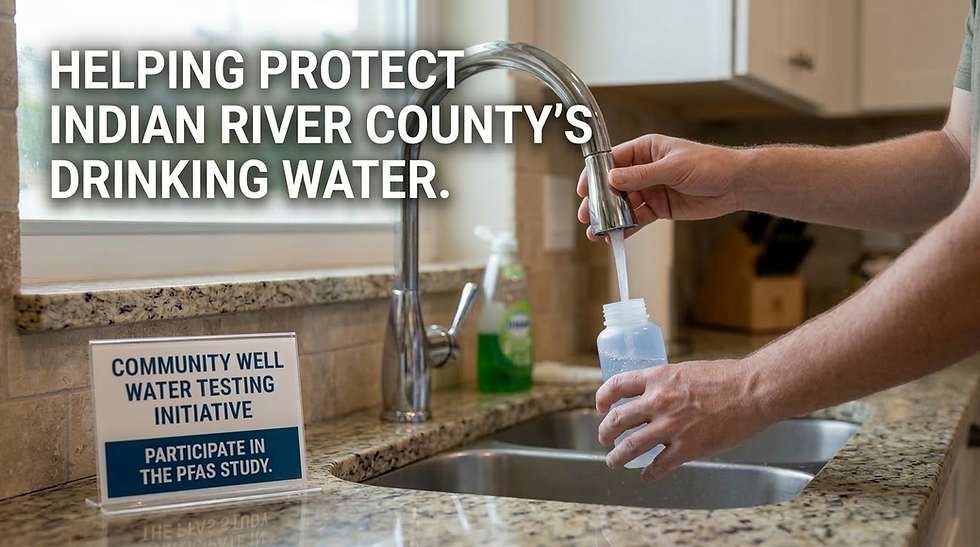
PFAS Well Water Testing
IRNA is offering free, certified lab testing for PFAS ("forever chemicals") in private drinking water wells. Sign up, submit your water sample, and get your results, plus learn what they mean for your health.
We are especially searching for wells at or near Blue Cypress Lake, Fellsmere, Gifford, and Wabasso.
There are only a few tests left! Reach out today!
Open to Indian River County home and business owners on private wells only (not connected to municipal water). Questions? Contact Missy@IndianRiverNA.com

A Look at the County's 2025 Report
Indian River County's Department of Utility Services (IRCDUS) has released its Annual Water Quality Report for 2025, and the news is mostly reassuring, with a few items worth watching.
The county's drinking water met all health-based standards this year. No contaminant tripped a Maximum Contaminant Level (MCL) violation, and both lead and copper came in well below their action levels at the tap. Notably, PFAS (the "forever chemicals" we've been tracking closely at IRNA) and lithium were both listed as "not detected" in the county's 2024 unregulated contaminant testing. That's a welcome result, though it's worth remembering these tests cover the county utility's system, not the private wells many of our neighbors still rely on.
Two things caught our eye. First, disinfection byproducts. Total trihalomethanes (TTHMs), a byproduct of chlorinating drinking water, averaged 63.95 ppb against an MCL of 80. Two individual sampling sites actually exceeded that 80 ppb ceiling on specific dates last year (on Old Dixie Highway and on A1A, peaking at 84.6 ppb). The county didn't incur a violation because compliance is based on the annual average across all sites, which stayed under the limit. Still, it's a reminder that byproducts of treatment are their own balancing act, and long-term exposure above the limit carries real health concerns.
Second, a paperwork problem. The county disclosed a reporting violation: it missed the October 10, 2025 deadline to submit its triennial lead and copper tap sampling results, filing them 19 days late. This was a procedural lapse, not a water-safety failure (the actual lead and copper numbers were fine), and the utility says it has revised its sampling workflow to build in a 45-day buffer going forward.
The report leans hard into water conservation, tying it directly to protecting the Indian River Lagoon, and it points residents to an interactive map where you can look up whether your service line contains lead.
If you have questions about the report or your own service, IRCDUS can be reached at (772) 226-3416, and lead-specific testing questions go to (772) 770-5300.

Amendment 3 is 'pivotal moment' for Florida, Indian River County says (TCPalm) - Indian River County officials warn that the passage of Amendment 3 could force significant budget cuts, employee layoffs, and reductions in essential public services due to an estimated $41 million loss in property tax revenue over two years.
Florida tax plan may cost 1 in 3 Martin County Firefighters their Jobs (TCPalm) - A proposed statewide property-tax reform on the November ballot could force Martin County to lay off over 30% of its firefighters or eliminate crucial emergency response units due to significant revenue losses.
Data center donors have spent more than $20 million in Florida ahead of the 2026 elections (Jason Garcia) - Data centers demand enormous amounts of electricity and water, and the industry has spent over $22 million influencing Florida's 2026 races and the regulators who oversee both. Follow the money before you vote.
Florida governor’s betrayal of clean water promise reaches peak with biosolids veto (Florida Phoenix) - Florida environmental advocates and biosolid processors expressed sharp opposition to Governor Ron DeSantis's veto of legislation designed to regulate and track the disposal of processed sewage sludge.
Back on Track: The Building That Put Vero on the Map Reopens (Vero Minute) - The Indian River County Historical Society has officially reopened the historic Vero Beach Railroad Station & Exhibit Center after six years of closure and extensive volunteer restoration efforts.

On Property Taxes: What We Left Out Last Week
We mentioned last week that the Legislature reached for a sledgehammer to solve a problem that needed a scalpel. Rebuilding how an entire state funds its basic infrastructure deserves patience and deep study, not a rush job. Constitutional amendments are basically permanent, and a three day Special Session isn't how you responsibly rewrite the way the state, cities, and counties pay for themselves.
Look at property insurance, which for years was the scariest line on any Florida homeowner's bill. Nobody rewrote the constitution to fix it. Through targeted policy, the market is finally leveling off. Citizens approved its first rate cut since 2015 (an average 8.7% drop), private carriers are filing decreases, and reinsurance costs dropped sharply this year. That's proof of what patient, targeted policy can do. Property taxes deserved that same care.
The frustrating part is that narrower fixes were right there on the table. Expanding the existing exemptions for widows and widowers, the elderly, and the permanently disabled by another $25,000 to $50,000 would protect the people most likely to be taxed out of homes they've owned for decades. A modest $50,000 homestead bump would give everyday families meaningful relief without blowing a hole in county safety budgets. Those are surgical tools, and they help the neighbors who actually need it rather than handing a blanket break to newcomers buying million dollar homes.
Instead, Amendment 3 applies a blunt, across the board formula that treats every local government the same. Rather than a modest bump, it nearly quintuples the homestead exemption (from the current $50,000 to $150,000 in 2027, then $250,000 in 2028) for all 50,916 homestead properties in the county. It assumes every county is hiding fat that a big exemption will force it to trim. But Indian River County is already run efficiently (our leaders have spent 20 years cutting staff and keeping millage rates among the lowest in the state).
There's no hidden pile of excess sitting around to absorb the projected hit, which County Administrator John Titkanich now pegs at $22 million in lost property-tax revenue the first year and $41 million the year after (roughly $63 million over two years). That's real money in a county whose entire budget runs about $598 million, with property taxes covering only about a third of it. The county has already laid off seven employees and warns that more cuts would follow if the amendment passes.
An across the board cut doesn't punish waste in a prudent county. It punishes the essential services (fire rescue, parks, water quality, beach renourishment, and the like) that a lean county has already trimmed over the years.
So before you vote this November, do your homework. Ask your county commissioner what gets cut first. Ask a commercial property manager how the fee shifts land on renters and small businesses. A permanent change to the constitution deserves more than a three day rush job, and it deserves more than a gut-check vote.
Why “Alligator Alcatraz” fell, and what must come next (Friends of the Everglades) - Legal action and public accountability efforts by environmental groups led to the closure of an immigration detention center in Big Cypress that caused significant ecological and financial damage.
SFWMD budget crunch: What does it mean for Everglades restoration? (VoteWater.org) - Gil Smart argues that rising operational costs and a massive maintenance backlog may force the South Florida Water Management District to prioritize traditional flood control over critical Everglades restoration efforts.
Florida DOH issues toxic algae alert for Lake Okeechobee Martin County (TCPalm) - The Florida Department of Health issued a water advisory after toxic blue-green algae was detected in a Martin County portion of Lake Okeechobee, urging residents and visitors to take precautions against exposure.
Summer safety tips for swimming in Florida lakes, wildlife to look for (TCPalm) - While swimming in Florida lakes carries risks from alligators, venomous snakes, and harmful bacteria, visitors can minimize danger by swimming only during daylight in designated areas and keeping a safe distance from wildlife.
Planned data center in Florida held back by lack of available water from city (DCD) - Cielo's plans to develop a 300MW data center campus in Haines City, Florida, are currently delayed because the municipality lacks the water infrastructure capacity required to meet the project's daily demand.
People may not need to touch Florida’s toxic algae blooms to be exposed; scientists found their toxins travelling through the air (The Times of India) - Researchers have discovered that toxic cyanobacteria blooms in Florida produce airborne neurotoxins, placing individuals at risk of chronic respiratory exposure and neurodegenerative conditions like ALS even without direct water contact.


Comments