
IRNA Lunch Jan. 28, Wetlands are in Trouble, and more

December 13, 2025 Weekly Newsletter
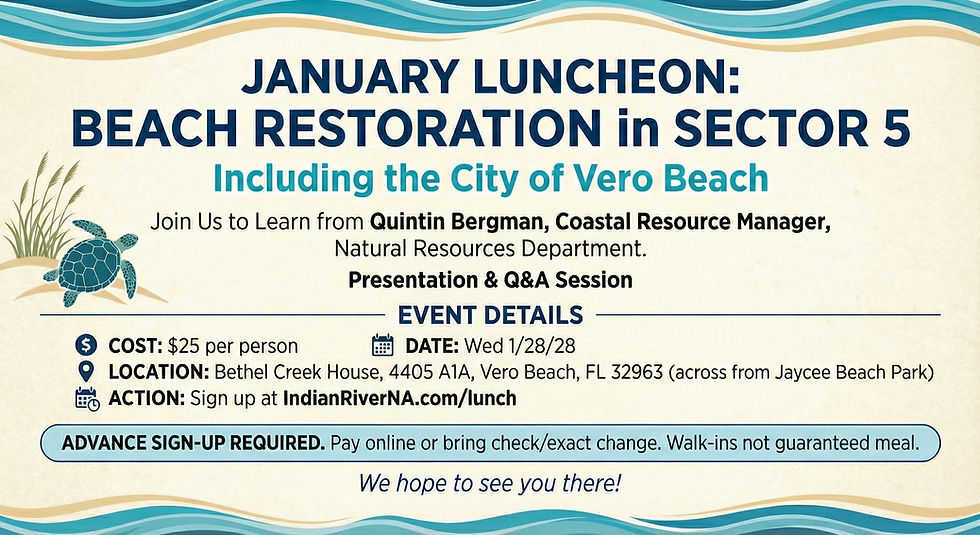
Join Us for a Luncheon on January 28!
Learn about Beach Restoration in Vero Beach from Quintin Bergman, Coastal Resource Manager with the Natural Resources Department. There will be time for questions following the presentation.
Details:
Cost: $25 per person
Location: Bethel Creek House, 4405 A1A, Vero Beach, FL 32963 (across from Jaycee Beach Park)
Sign up at IndianRiverNA.com/lunch
You can pay online when you register, or bring a check or exact change the day of. Please sign up in advance, we cannot guarantee walk-ins will be able to eat.
We hope to see you there!

New here? If this was forwarded to you, we'd love to have you join our community! Click here to sign up and receive our newsletter weekly.
Join the IRNA in building a stronger voice for our community. Your support empowers us to safeguard our natural resources, demand transparency from elected officials, and champion the changes we need to see—together, we can create lasting impact.

Florida's Wetlands Are Caught Between a Failed Experiment and a Federal Retreat
If you've been following Florida environmental policy, you might have whiplash. In the span of a few years, we've watched the state grab control of wetland permitting, bungle it spectacularly, lose it in court, and now face a federal government that seems determined to walk away from protecting wetlands altogether.
For decades, if you wanted to fill a wetland in Florida, you needed a permit from the U.S. Army Corps of Engineers under Section 404 of the Clean Water Act. This federal oversight came with strings attached. Most importantly it came with consultation requirements under the Endangered Species Act to make sure your project wouldn't push the Florida panther or wood stork closer to extinction.
Florida officials argued this was redundant. The state already had its own Environmental Resource Permit program. Why make developers jump through two hoops? In 2018, the legislature authorized pursuit of "assumption"—taking over the federal 404 program. Only Michigan and New Jersey had done this before, and neither had attempted it in nearly three decades.
The pitch was efficiency. Faster permits. Less bureaucracy. One-stop shopping for development approvals.
Here's the thing about assumption: it doesn't just transfer paperwork. It transfers legal responsibility. And the Endangered Species Act creates a serious problem.
When the Corps processes a permit, that's a federal action. Federal actions trigger mandatory consultation with the Fish and Wildlife Service. Developers get what's called an "incidental take statement"—essentially legal cover if their project accidentally harms a listed species.
When a state issues the permit? No federal action. No automatic consultation. No legal protection for developers.
Florida's solution was creative but legally rickety. The Fish and Wildlife Service would provide "technical assistance" on permits that might affect species. They'd recommend conditions, the state would include them, and a blanket incidental take statement would cover everything.
The problem? That incidental take statement had no numbers. No limits. No trigger to say "stop, we've authorized too much harm." It was, as the court later described it, essentially a blank check.
Florida processed thousands of permits under this system. Environmental groups raised alarms about transparency and whether the technical assistance process had any teeth. Projects in sensitive panther habitat moved forward without the cumulative impact analysis that federal review would have required.
In February 2024, Judge Randolph Moss found fundamental structural failures with Florida's program. The Endangered Species Act demands specificity. You can't authorize unlimited take of endangered species and call it conservation.
The judge vacated Florida's authority entirely. Not a slap on the wrist. Not a remand to fix some paperwork. Complete vacatur. More than a thousand pending applications were frozen overnight.
Florida tried to negotiate a compromise: let us keep processing the 90% of permits with no species impacts, and we'll send the tricky ones to the Corps. The judge said no. The whole point was that Florida's process for determining which permits had "no effect" on species was the problem. He couldn't trust the state to sort the pile.
The case is now on appeal, but nearly two years later, the Corps remains the permitting authority in Florida. The EPA's own website confirms it.
You might think this was a win for wetlands. Federal oversight is back. Section 7 consultations are happening again. Panthers and wood storks have their legal shield restored.
But here's where things get dark.
The Supreme Court's 2023 Sackett decision fundamentally changed what counts as a "Water of the United States." Gone is the "significant nexus" test that protected wetlands with groundwater connections or ecological ties to navigable waters. Now, a wetland must have a "continuous surface connection" to a relatively permanent body of water. If you can tell where the water ends and the wetland begins, it's probably not protected.
This is especially devastating for Florida. Our geology is karst—porous limestone where water moves underground. Cypress domes fill with rain, filter pollutants, recharge our aquifer, and provide critical habitat. They rarely have surface connections to rivers. Under Sackett, they're legally invisible.
The current administration's November 2025 WOTUS proposal takes Sackett and runs with it. Waters must contain surface water "at least during the wet season." Wetlands behind levees or separated by roads? Excluded. The Environmental Defense Fund estimates up to 9.5 million acres of Florida wetlands could lose federal protection.
Environmental groups fought hard to return permitting to federal hands precisely because of the ESA protections. They won. But the federal government is now defining away its own jurisdiction.
Much of Florida's wetlands now depend on state law, the same Environmental Resource Permit program that state officials once argued was sufficient on its own. Maybe they'll be right. But state programs are more susceptible to legislative tinkering and local political pressure than federal statutes.
The Corps is understaffed and overwhelmed with the applications that came flooding back after the vacatur. Permit delays have stretched from months to years. The mitigation banking market is in chaos, with federal credits potentially worthless for wetlands that no longer qualify as federal waters.
And somewhere in Southwest Florida, the remaining 200-odd Florida panthers are navigating a landscape where the rules about what can be developed (and who gets to decide) change depending on which court ruling you're reading and which definition of "wetland" is in effect this month.
Florida tried to streamline wetland protection and proved they couldn't be trusted with it. Now we're watching the federal government decide that maybe wetlands just aren't worth protecting at all.
Neither outcome serves the water, the wildlife, or the people who depend on both.

Breeze Airways to launch seasonal nonstop flights from Vero Beach to Raleigh (Sebastian Daily) - Breeze Airways will launch seasonal nonstop flights between Vero Beach and Raleigh starting May 6, expanding its low-cost service offerings at Vero Beach Regional Airport amid a broader growth in regional air travel options.
Sebastian Council signs off on Hawk’s Landing plan (hometownnewstc.com) - The Sebastian City Council approved a 162-unit Hawk’s Landing townhome development despite resident concerns over compatibility, affordability, and seawall maintenance, with the project promising public amenities, 40% open space, and “essential housing,” but facing criticism for deviating from earlier expectations of affordable single-family homes.
Tourism tax revenues soar past projections (Vero News) - Indian River County’s tourism tax revenues hit a record $5.56 million in fiscal year 2024–2025—boosted by increased visitors, a higher bed tax rate, and strong marketing—with future growth expected from nearly 900 proposed new hotel rooms that could add at least $1 million more annually.
Three Corners site work launches with sewer tank demolition (Vero News) - Demolition of a reclaimed-water tank on the south side of Vero Beach’s Three Corners site has cleared the way for the Youth Sailing Foundation’s new 10,000-square-foot center, marking the first visible step in the site's redevelopment while the city advances plans for broader waterfront transformation and prepares to negotiate with its chosen developer.
Bill bans local governments from regulating wetlands and water pollution (Yahoo News) - A new Florida bill (SB 718) would ban local governments from regulating wetlands or water pollution, continuing a legislative trend of preempting local control in favor of state-level rules favored by developers, and drawing criticism from counties trying to protect rural and environmentally sensitive lands.

The Squeeze Gets Tighter:
FPL's $7 Billion Rate Hike Lands
on an Already Struggling Florida
Half of Floridians are thinking about leaving.
That's not hyperbole, it's what a recent Florida Atlantic University poll found. Roughly 50 percent of residents are "seriously" or "somewhat" considering packing up because of the cost of living.
Florida now leads the nation in foreclosures. Tampa holds the dubious honor of having the highest foreclosure rate among major metros. Property insurance premiums average $2,625 a year (24 percent above the national average) and in Miami-Dade, you're looking at over $5,000. The citrus industry, once a symbol of Florida prosperity, just posted its lowest output since the 1930s.
Into this mess steps Florida Power & Light with the largest utility rate hike in the country.
What It Means for Your Bill
On November 20th, the Florida Public Service Commission approved a $6.9 billion rate increase for FPL through 2029. For the typical household using 1,000 kWh per month, that works out to about $14 more each month by 2029, roughly $170 extra per year, permanently baked into your bill.
FPL will tell you the January 2026 increase is only $3.79 per month, and that your overall bill might actually drop slightly because a temporary $12.02 hurricane surcharge expires in December. That's technically true. But the storm charge was always temporary. The base rate increase is forever.
Why This Is Happening
Three reasons stand out.
First, FPL's profit margin. The company secured a 10.95% return on equity, nearly 1.5 percentage points above the national average. According to economist Daniel Lawton, who testified before the PSC, each percentage point of ROE equals about $500 million extracted from customers. That spread represents hundreds of millions annually flowing to NextEra Energy shareholders rather than staying in Floridians' pockets.
Second, data centers got a sweetheart deal. FPL originally proposed hiking rates on these energy-intensive facilities by 65 percent. Instead, the final settlement lets smaller data centers save over 50 percent on their bills. Someone has to make up that revenue shortfall, and that someone is residential ratepayers.
Third, the process itself was broken. The Office of Public Counsel, the state's statutory consumer advocate, was shut out of the settlement negotiations. When they proposed a $5 billion alternative that would have frozen rates for two years, the PSC rejected it, ruling that FPL was an "indispensable party" to any deal. Translation: the utility has veto power over any agreement meant to protect you.
Chief Justice Carlos Muñiz has called the PSC a "black box" and he's not wrong. The commission suspended evidentiary hearings that would have allowed cross-examination of FPL's claims. The public never got its day in court.
Appeals are coming, and this fight may land before the Florida Supreme Court. But for now, the message from Tallahassee is clear: when push comes to shove, utility shareholders come first.
Six bills, one agenda: Sen. McClain pushes pro-development blitz (VoteWater.org) - Sen. Stan McClain has filed six aggressively pro-development bills for Florida’s 2026 legislative session that would strip local governments of authority over wetlands, water quality, zoning, impact fees, and public input on large-scale developments—cementing state-level control in favor of developers and sidelining citizen involvement.
Florida wildlife agency’s leaders claim they don’t have to follow science (Florida Phoenix) - Florida wildlife commissioners, appointed by Gov. DeSantis, approved a controversial bear hunt despite scientific evidence showing declining bear populations, manipulating data to justify the decision and ignoring both public opposition and conservation principles.
Land Trust benefit: In praise of preserving precious spaces (Vero News) - Supporters gathered at the Indian River Land Trust’s annual benefit to celebrate recent conservation successes, including land acquisitions, lagoon restoration efforts, and a $1 million matching pledge to support ongoing habitat and waterway protection projects across Indian River County.
December 2025 Peligram (Pelican Island Audubon Society) - This issue details a successful adult nature camp, a call for political accountability over weakened water protection laws like HB 105, ongoing efforts to convert septic systems to sewer near the Indian River Lagoon, upcoming RiverKidz events and field trips, fundraising successes including a wine raffle, and the launch of a $1 million matching campaign to support the Coastal Oaks Preserve restoration.


Comments