
Police and Firefighters on Amendment 3, How to Save More Water, and More

August 1, 2026 Weekly Newsletter

Why Florida's Police and Firefighters Oppose Amendment 3
Two of Florida's largest public safety unions have lined up against Amendment 3, and their reasoning comes down to a single worry: the money that pays for emergency services would disappear before anyone has figured out how to replace it.
The Florida State Fraternal Order of Police (representing over 24,000 officers, making it the state's second-largest police union) and the Florida Professional Firefighters (over 28,000 members) both object to the same thing. Local governments lean heavily on property taxes to fund police and fire departments, and the amendment would cut deeply into that revenue without a state plan to fill the gap. State economists estimate Amendment 3 would reduce local budgets by about $5 billion in its first year, climbing to roughly $11.8 billion a year after five years (the same budgets that cover officers, firefighters, equipment, and 911 dispatchers). The unions fear the shortfall translates directly into hiring freezes, layoffs, and slower emergency response.
The FOP announced its opposition in late July 2026. President Jeff Stinson framed it as a matter of not gambling with people's safety, arguing that public safety shouldn't become collateral damage over fiscal uncertainty. Notably, the union isn't dismissing the idea of tax relief. It says it understands the pressure homeowners are under and supports responsible reform (just not a version that forces communities to pick between lower taxes and a fully funded police force). Worth noting, too: the FOP is the state's second-largest police union. The largest, the Florida Police Benevolent Association (more than 30,000 officers), has not yet taken a position on the amendment.
The firefighters made a similar case. Their position is that they can't get behind a proposal that could jeopardize fire protection, EMS, and disaster response until there's a reliable plan to fund those services. Union president Wayne "Bernie" Bernoska told members the group intends to educate them on the amendment's implications and expand its public outreach in the coming months, adding that the stance isn't about opposing tax reform but about protecting the people they serve every day. And they point out this isn't hypothetical. In Volusia County, firefighters note a countywide hiring freeze is already in place, and they warn they can't afford to lose the momentum they've worked to build.
They weren't the first public safety group to speak up. The Florida Fire Chiefs' Association issued its own opposition statement on July 15, saying it couldn't support the amendment in its current form until a comprehensive funding plan exists to preserve local governments' ability to provide these services.
The political backdrop adds another wrinkle. Governor Ron DeSantis, who originally championed property tax relief, decided last month not to campaign for Amendment 3. The Florida Democratic Party has come out against the measure, while the Republican Party of Florida has yet to take a public stance.
The bottom line for all three groups is they aren't opposed to property tax relief itself, but they want state leaders to establish a dependable, legally binding plan to replace the lost revenue before cutting the funding that emergency services depend on.
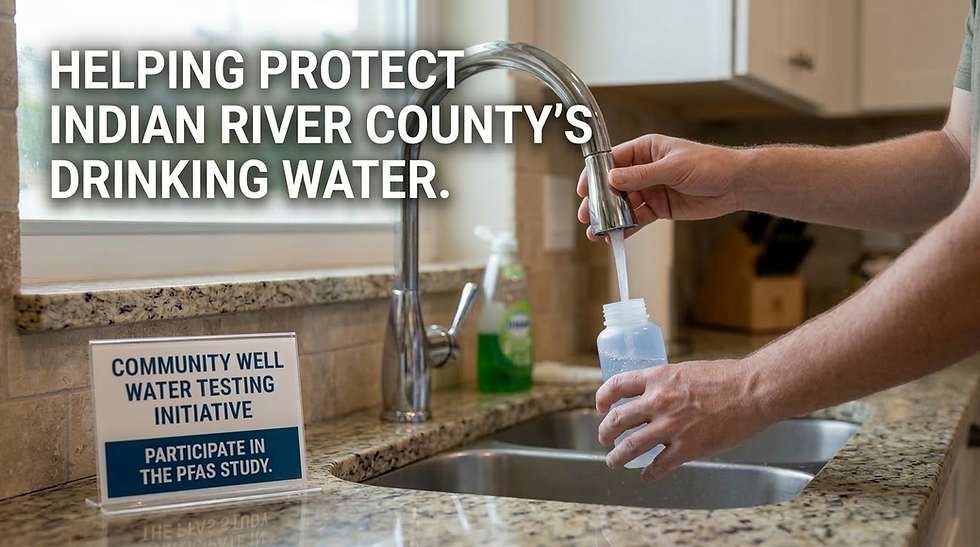
PFAS Well Water Testing
IRNA is offering free, certified lab testing for PFAS ("forever chemicals") in private drinking water wells. Sign up, submit your water sample, and get your results, plus learn what they mean for your health.
We are especially searching for wells at or near Blue Cypress Lake, Fellsmere, Gifford, and Wabasso. There are only a few tests left! Reach out today!
Open to Indian River County home and business owners on private wells only (not connected to municipal water).
Questions? Contact Missy@IndianRiverNA.com
New here? If this was forwarded to you, we'd love to have you join our community! Click here to sign up and receive our newsletter weekly.
Stand with the IRNA and help us amplify our community's voice. Your support fuels the fight to protect our natural resources, hold elected officials accountable, and drive the real change our neighborhoods deserve. Together, we don't just speak up, we make an impact that lasts.

Don't you hate it when you drive past a house and see the sprinklers going full blast in the middle of a rainstorm? It's one of those small absurdities that makes you want to knock on the door and say something. But before we judge our neighbors too harshly, most of us have no idea how our own irrigation systems actually work, and that's where the real waste hides.
Here's the good news: your system isn't as mysterious as it looks. At its heart is the controller (usually tucked in the garage), which acts as the brain, deciding when each zone runs and for how long. From there, underground valves take orders from the controller and switch each zone on and off, sending water through the pipes out to the sprinkler heads. Most Florida yards have three to five zones, and a well-designed system keeps spray heads and rotors in separate zones since they put out water at very different rates.
The biggest thing you can do to save water (and money) is water at the right time, and this is the law. Indian River County follows the St. Johns River Water Management District's standard schedule, which sets your watering days by address and season. During daylight saving time (second Sunday in March to first Sunday in November), odd-numbered or no-address homes water Wednesday and Saturday, even-numbered homes water Thursday and Sunday, and nonresidential properties water Tuesday and Friday. In Eastern Standard Time (the winter stretch), it drops to one day a week: odd addresses on Saturday, even on Sunday, nonresidential on Tuesday. Either way, no watering between 10 a.m. and 4 p.m. (when heat and wind waste the most to evaporation), and no more than one hour per zone. These rules cover private wells, surface water, and utility water alike.
The amount matters too. Three-quarters of an inch per watering is plenty for most Florida soils, and overwatering actually invites weeds, fungus, and disease. Not sure how much you're putting down? Try the "catch can" trick: scatter a few tuna-can-sized containers around a zone, run it like normal, then measure and average the depth. That tells you exactly how long you need to run to hit that three-quarter-inch mark.
Then there's the rain problem, which brings us back to those soggy sprinklers. Florida law has required a working rain sensor on automatic systems installed since 1991. That little device swells up when it gets wet and temporarily shuts the system off, then resets as it dries. If yours is buried under a bush or blocked by a roof overhang, it can't do its job, so check it once a year. If you want to go further, smart controllers use weather data or soil moisture readings to water only when your yard actually needs it, cutting outdoor water use by 20 to 40 percent.
A few more easy wins: raise sprinkler heads that have sunk into the grass, fix broken or misdirected ones so you're not watering the sidewalk, and switch to micro-irrigation (drip lines and soaker hoses) in your planting beds, which need about half the water of turf. And turn the whole thing off during rainy stretches.
So the next time you spot those raining-day sprinklers, take it as a reminder to go check your own setup. A few minutes with your controller and a handful of tuna cans might be all it takes to stop being that house.


Habitat builds more than homes (Hometown News TC) - Indian River Habitat for Humanity provides low-income and working families in Indian River County with long-term stability and empowerment by pairing affordable homeownership opportunities with financial education, housing counseling, and community support.
Tornado touches down in Sebastian (Hometown News TC) - The National Weather Service confirmed that a low-end EF-0 tornado with 65-85 mph winds touched down in Sebastian on Friday, July 17, leaving minor damage and no reported injuries.
'Mystery object' that fell from sky into ocean causes multi-agency search (Vero News) - Multiple emergency response agencies conducted a 40-square-mile ocean search off Treasure Shores Beach Park after a beachgoer reported a mystery object falling from the sky into the Atlantic Ocean, but officials found no evidence or debris of a crashed aircraft.
Shores residents want help paying for mandated septic-to-sewer switches (Vero News) - More than 70 Indian River Shores homeowners petitioned local officials for financial assistance and grant funding to help cover mandated septic-to-sewer conversion costs that could exceed $40,000 per household.
Florida city awaiting state review on proposed mega 55+ development (TCPalm) - The Sebastian City Council granted preliminary approval for a land-use and zoning change to convert 382 acres of annexed agricultural land into Cresswind, a proposed 900-home active adult community by Kolter Homes.

Florida Bucks the Trend as Home Solar Booms in the Sunshine State
While the residential solar market is contracting nationwide, one state is proving to be a standout exception: Florida.
A big reason is a sweeping permitting law that took effect last summer, with new rules aimed at making it both faster and cheaper to install rooftop solar. Florida installed more than 110 megawatts of home solar in the first three months of the year, and it seems we're now the fastest-growing state for residential solar in the country. In the first 13 weeks of the year alone, Florida led the nation with approved permits for at least 450 megawatts-worth of projects, a fourfold increase over the same period in the previous two years.
Not all of that is brand-new momentum. Some of the early-2026 growth reflects projects locked in last year, when homeowners rushed to start before the federal tax credit were removed. But even accounting for that hangover, the state is holding up far better than the rest of the country.
Streamlining permitting is a bipartisan policy with broad support, and several states (including California and Maryland) have adopted similar laws. But Florida's version stands out because it applies to a number of construction trades, not just solar contractors, which widened its appeal. The law shrank permit approval times to within five days from 20, and it officially allows third parties to inspect solar systems statewide, a job previously handled largely by government. It also permits remote inspections using photos, videos, or drone footage. The added flexibility is expected to lower project costs.
Florida's other pro-solar policies are helping too. It remains one of the few states to allow net metering at a time when electricity prices are climbing, giving homeowners credits for extra solar electricity they produce but don't use.
The average residential solar project in the US costs around $31,000, with soft costs (permits, inspections, fees, and labor) making up roughly 30% of that total. Florida's policies are now helping bring those costs down. As a result, the state could see 710 megawatts installed in 2026, up 62% from the 439 megawatts installed in 2025.
Florida also passed another law this year expanding its reforms. Starting in 2027, a universal residential building permit application will replace the patchwork of different forms each local jurisdiction currently requires for solar and other single trades, a change experts say will further speed up projects and cut costs.
New law has Florida 'open for business' for AI data centers, utility execs say (Substack) - A newly signed Florida law intended to regulate large artificial intelligence data centers has instead spurred increased development interest across the state by offering regulatory certainty to utility companies and tech investors.
Sample Ballots for August 18 Primary Election Are Being Mailed to Voters (Vero News) - The Indian River County Supervisor of Elections Office is mailing sample ballots to registered voters to help them prepare, review polling locations, and familiarize themselves with closed primary rules ahead of the August 18 Primary Election.
54 Florida condo buildings deemed 'unsafe or uninhabitable' (TCPalm) - Mandatory milestone inspections following the 2021 Surfside collapse revealed substantial structural deterioration in nearly 30 percent of inspected Florida condominium buildings, leading to 54 being deemed unsafe or uninhabitable and five being evacuated for repairs.
Florida needs more environmental scientists (Florida Today) - Justin Aycock highlights that Florida high schools are preparing the next generation of environmental scientists to address critical water management challenges by offering industry-recognized credentials such as the Ducks Unlimited Ecology Conservation & Management Certification.
The Fontainebleau wanted another favor from the Florida Legislature (Substack) - A useful case study in how legislation gets written in Florida: Jason Garcia documents how lobbyists for the Fontainebleau Hotel drafted condo-law changes to benefit the hotel, echoing a pattern where industry lobbyists author the bills that favor them (other groups like Mosaic did the same on phosphate-mining liability). Worth a read on how influence works in Tallahassee.


Comments