
The Ghosts of Developments Past, Elections, and more


The Ghosts of Developments Past
You have driven past them without knowing what you were looking at. A concrete wall along a county road with nothing behind it. A street sign standing in a field, marking an intersection nobody has ever turned at. Paved roads running through scrub toward houses that were never built. There are more of these around Indian River County than you would guess, and most of them have been sitting there since about 2008.
Planners call these zombie subdivisions, a term from a 2014 Lincoln Institute of Land Policy report on the half-finished projects the crash left behind across the country. We have a very good local collection.
Nature can move quickly. Give a cleared field fifteen years and the scrub comes back, the pepper trees move in, the pond edges vegetate, and gopher tortoises start (or keep) digging burrows where the lots were supposed to go. If you walked one today without knowing its history, you might think of it as overgrown pasture with some unusually nice drainage.
The land recovers. The approval doesn't, and it doesn't decay either. A development order is a piece of paper, and that paper doesn't care that the market crashed, that the original developer went under, that the county's rules changed three times since, or that the science on lagoon nutrient loading moved substantially in the meantime. It just sits in a file, fully intact, waiting. So the tortoises and the entitlement are occupying the same ground.
Once the roads and the ponds and the utility lines are in the ground, the economics change permanently. Finishing the project becomes dramatically cheaper than starting one somewhere else, and undoing it becomes almost unthinkable, because who pays to rip out four miles of pavement? Every dollar the original developer sank into that dirt in 2006 is a dollar of gravity pulling the project back toward completion, no matter how long it takes or how many times the property changes hands.
That gravity outlasts every argument anyone made about whether the project was a good idea. Take Bluewater Bay, off County Road 510 across from Treasure Coast Elementary. The debate happened in 2005. The wall went up in 2006. Everything since has been a matter of waiting for someone with capital to notice, and this year somebody did.
None of this is new here. Indian River County's parcel numbering system still carries the scars of Fellsmere Farms, a 1910s land boom subdivision that platted four entire townships. Indian River Farms platted portions of three more. In the 1950s through the 1970s Florida ran the same play at industrial scale, and the state ended up with Lehigh Acres, Cape Coral, Port St. Lucie, and Golden Gate Estates: millions of lots sold sight unseen, many of them wet, most of them nowhere near a road or a pipe. Florida planners call these "antiquated subdivisions," and the state has been trying to unwind them for fifty years with limited success.
You do not have to go far to see one. Vero Lake Estates sits directly across 90th Avenue from Bluewater Bay. It is an antiquated subdivision that woke up slowly over decades, and it now has roughly 6,800 people living on a grid laid out before anyone thought hard about septic density or lagoon nutrients. The county has been working on that problem for years and will be for years more.
So on one side of 90th Avenue you have a ghost from the 1960s that took sixty years to fill in. On the other side you have a ghost from 2005 that is about to fill in all at once.
Finishing a zombie subdivision is usually better than starting fresh elsehwere. The land is already cleared, so there's no habitat left to lose. The infrastructure is sunk, so completing it wastes less than building the same houses on new ground somewhere else. Bluewater Bay is coming back on county water and sewer rather than 374 septic systems, and in a lagoon basin under an enforceable nutrient plan, that is a real though unglamorous improvement. If these projects have to happen, and legally they mostly do, this is close to the best version.
A project approved in 2005 often gets built to 2005 assumptions, and the stormwater system is where that bites hardest. The ponds were designed under the criteria of that era, and Florida's treatment standards have tightened significantly since, particularly for anything draining toward an impaired water body. The rest is frozen too (the traffic study reflects a road network from before the last two decades of growth, and the buffers, tree standards, and utility specs are all a snapshot of what we required twenty years ago), but water is the piece that doesn't get a second chance.
Developers are not always building a 2026 subdivision in 2026. Sometimes they are unfreezing a 2005 one. The questions worth asking got settled before most of us were paying attention, so the only ones left are which parts are still running on twenty-year-old assumptions, and which of those we will still be living with in forty years. Usually that means the water. Roads get rebuilt and landscaping gets replaced, but the pipes and the ponds go in once, nobody looks at them again for decades, and they connect straight to the lagoon.
So keep an eye out for the wall with nothing behind it, or the street sign standing alone in a field. Sooner or later somebody finishes what's behind it, and by then the only question still worth asking is which decade's rules they finished it under.
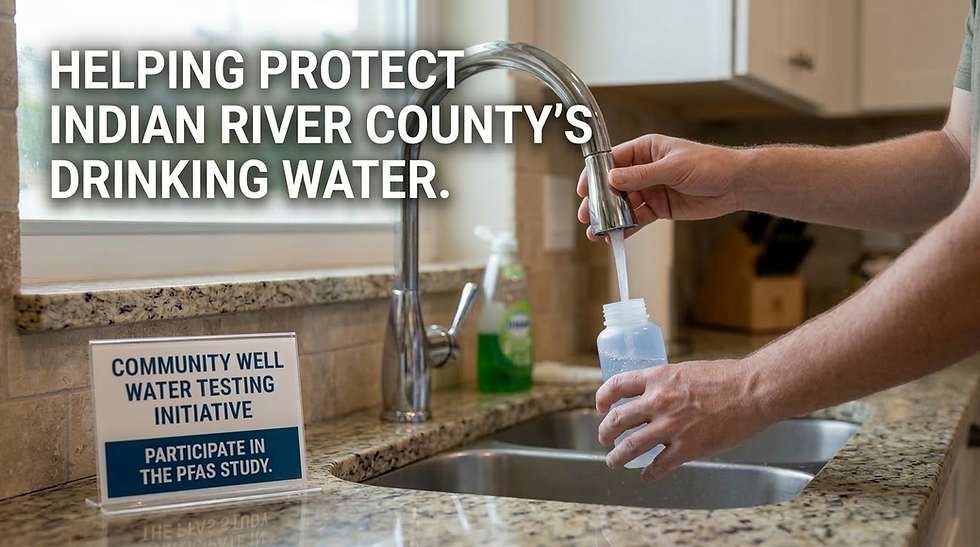
PFAS Well Water Testing
IRNA is offering free, certified lab testing for PFAS ("forever chemicals") in private drinking water wells.
Sign up, submit your water sample, and get your results, plus learn what they mean for your health.
We are especially searching for wells at or near Blue Cypress Lake, Fellsmere, Gifford, and Wabasso.
There are only a few tests left! Reach out today!
Open to Indian River County home and business owners on private wells only (not connected to municipal water). Questions? Contact Missy@IndianRiverNA.com

Congratulations to Jennifer Pippin, who won Tuesday's Republican primary for the District 2 County Commission seat with 41.57% of the vote, ahead of Sebastian City Council member Bob McPartlan (34.48%) and Daniel Brooks Robinson (23.95%). She advances to the Nov. 3 General Election, where she'll face Democrat Robert "Robbie" Hardingham and a write-in candidate for the seat being vacated by four-term incumbent Joe Flescher.
In District 4, Daryl Loar and Marc Jaffe were both unopposed in the primary and will meet in November.
We also want to say thank you to everyone who put their name on the ballot. Running for local office is a real sacrifice (of time, of privacy, of family evenings and weekends) and it doesn't come with much of a safety net. Whether you won, lost, or are still campaigning, we thank you for stepping up to serve Indian River County.
The work ahead is significant. Water quality, growth management, and infrastructure that keeps pace with development are going to define the next four years for this county. We look forward to continuing the conversation with all of the November candidates, and we'll keep our members informed as the general election approaches.

Vero Beach area homeowner tax bills potentially misleading | Opinion (TCPalm) - Laurence Reisman explains how a database discrepancy on Indian River County property tax notices overstated proposed increases for waste collection, and argues the error gives a distorted picture ahead of November's homestead exemption vote.
Is repair work on 17th Street bridge actually (dare we ask) almost done? (Vero News) - The Florida Department of Transportation estimates that the multi-year, $24.3 million repair project on Vero Beach's 17th Street bridge is approximately 98 percent finished, with final pavement marking underway and full completion anticipated by the end of the summer.
Indian River County hosts free workshops on sewer conversion project (Sebastian Daily) - Indian River County is hosting a series of free public workshops throughout September to inform property owners about requirements, costs, financial assistance, and environmental benefits associated with the countywide sewer conversion project.
Shores to get three new council members, sans election (Vero News) - Three new Town of Indian River Shores council members will take office without a contested election after running unopposed for open seats, preparing to address upcoming municipal utility, infrastructure, and budget issues.
Transformative new sailing center takes shape (Vero News) - The Youth Sailing Foundation is constructing a fully funded $6.4 million community sailing center and public marine recreation park along the Indian River Lagoon in Vero Beach, scheduled for a December opening to expand youth sailing programs, adult recreation, and community events.

City council races are crowded this year.
Vero Beach has three seats up and eight people running for them. Sebastian has two seats up and six candidates. That's a lot of names to sort through before you fill out a ballot.
Vero Beach (3 seats)
Davis Benedict
Brian Heady
Jay Kramer
Robert MacCallum
Linda Moore (incumbent)
John O'Connor
Aaron Vos (incumbent)
Tracey Lockwood Zudans
Sebastian (2 seats)
Todd Clifton
Robert Gable
Damien Gilliams
Richard Gillmor
Sherrie Matthews (incumbent)
Deborah Shellenberger
IRNA is again teaming up with the Clean Water Coalition of Indian River County and Pelican Island Audubon Society to put questions to these candidates on water and land use (the issues that end up shaping this place long after an election is over). We'll share what comes back.
If you have a question you'd like us to ask, or a topic you think deserves a spot on the list, send it our way here. We can't promise every question makes the cut, but we read all of them and we appreciate you taking the time.
The Lords Paramount of Florida - by Jason Garcia (Jason Garcia) - In this commentary, Jason Garcia examines how major corporate donors, tech companies, and wealthy contributors exert substantial influence over Florida politics by funneling millions of dollars into legislative leadership funds and state primary campaigns.
Florida Brightline station threatened as cities compete for funding (TCPalm) - Cocoa secured a $57 million federal grant to build a Brightline rail station, leaving Martin County without the necessary federal funds to meet its deadline for a planned station in Stuart.
Indrio Savannahs Preserve reopens after marsh restoration project (TCPalm) - St. Lucie County has reopened the Indrio Savannahs Preserve following an 18-month restoration project that reconnected a 35-acre lake to historic wetlands to naturally filter stormwater and improve wildlife habitat.
From NASA to SpaceX, rocket launches expected to surge in next decade (USA Today) - Commercial rocket launches across the United States are projected to surge over the next decade, driven by lunar exploration missions, commercial satellite deployments, expanding private aerospace operations, and proposed regulatory easing.


Comments