
Property Taxes on Water, AI Data Centers, and More

June 27, 2026 Weekly Newsletter

The Property Tax Fight's Hidden Casualty:
Your Water
There's a piece of the property tax amendment debate that almost nobody is talking about, and Eric Draper raised it online recently with a sharp point: Florida's water management districts are about to take a major hit, and unlike cities and counties, they have almost nowhere else to turn for the money.
Draper is worth listening to on this. Over a 30-year conservation career, he became one of Florida's leading advocates for water and land conservation and Everglades restoration, known for getting business and agency leaders to the same table. He's credited with helping secure billions in new conservation and restoration spending and shaping many of the state's major environmental policy decisions, including statewide campaigns that won voter approval for land conservation. When he flags a funding threat, it's grounded in knowing exactly how these dollars work.
Here's the problem. If voters approve the amendment this November, the non-school homestead exemption climbs to $150,000 in 2027 and $250,000 in 2028, cutting non-school property taxes by close to 30% statewide. (The lack of a formal fiscal analysis led the House to potentially understate the real impact too.) That's relief many homeowners want. But property taxes are the backbone of how Florida's five water management districts fund water supply, water quality, ecosystem restoration, and flood control.
Those districts are projected to collect about $698 million in property taxes in FY2026-27. The amendment would slice roughly $200 million off that. And water management districts don't have the fallback revenue that cities and counties do (permit fees are a small slice of their budgets, and state appropriations come earmarked for specific projects, not general operations). Notably, during the special session, legislators tried to amend the bill to let water management districts keep using property tax revenue like the school districts. That effort failed.
For us here in Indian River County, this lands squarely on the St. Johns River Water Management District, which is projected to collect $131 million in FY2026-27.
St. Johns is the district responsible for the waters that define this region, including the Indian River Lagoon. A roughly 30% cut to its property tax base would directly weaken the work of cleaning up polluted springs, rivers, lakes, and estuaries, meeting Central Florida's looming 95-million-gallon-per-day water supply shortfall, and repairing aging flood control canals.
And don't count on the state to backfill it. With the exception of Everglades restoration, Tallahassee has largely declined to help cover the cost of protecting and restoring water resources. State programs for groundwater, springs, the Indian River Lagoon, and other impaired waters are funded at minimal levels. Appropriations haven't kept up with alternative water supply costs, and DEP's water quality grant program has gone unfunded two years running. The Office of Economic and Demographic Research has documented billions in unfunded water supply and water quality needs. Meanwhile, the districts have been rolling back property taxes and losing spending power for the best part of fifteen years.
If the amendment passes and the Legislature doesn't replace the lost $200 million (and it almost certainly won't if history is anything to go by), the districts will have no choice but to cut.
The hard part, as Draper's point underscores, is that the water management districts can't really fight for themselves. Staff and board members have been removed before for not aligning with the Governor. Good water resource management needs friends willing to speak up where the districts can't.
So as this amendment heads to the November ballot, it's worth asking a question the headlines aren't: what happens to the lagoon, the springs, and the canals when the money that protects them quietly disappears? We will keep bringing the dangerous aspects of this proposal to you over the next few months. Share this and other articles we post to help spread the word!

PFAS Well Water Testing
IRNA is offering free, certified lab testing for PFAS ("forever chemicals") in private drinking water wells. Sign up, submit your water sample, and get your results, plus learn what they mean for your health.
We are especially searching for wells at or near Blue Cypress Lake, Fellsmere, Gifford, and Wabasso.
Open to Indian River County home and business owners on private wells only (not connected to municipal water). Questions? Contact Missy@IndianRiverNA.com
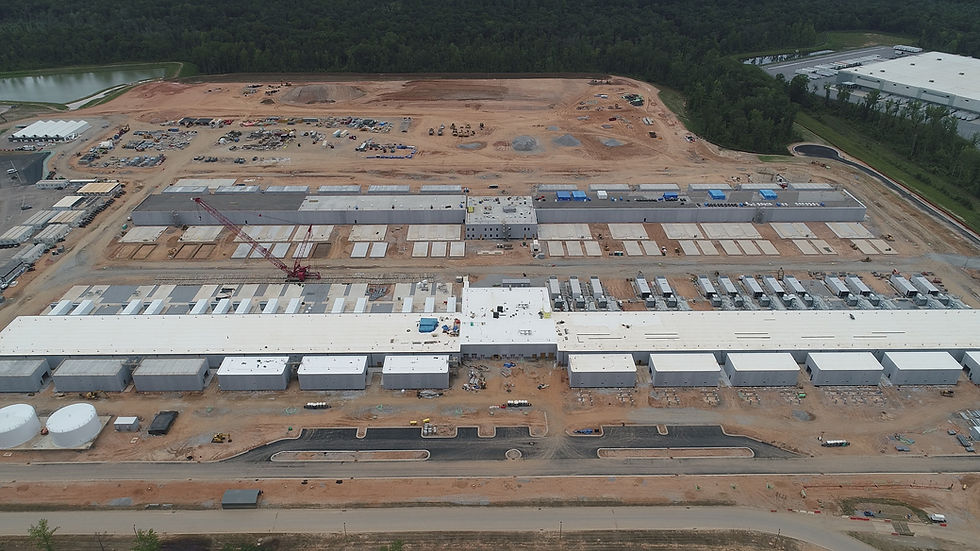
The Building Next Door That Drinks
Like a Small City
There's a website worth bookmarking: brockovichdatacenter.com. It maps the major AI data centers across the U.S. (operational, under construction, and proposed) and lets residents pin their own community's concerns right on top. It's self-reported and citizen-sourced (data the industry would rather stayed scattered). When the official channels are opaque, the unofficial ones become the public record.
So let's talk about why this matters, and why "it's just a data center, those have existed for decades" misses the point.
The category is old. The scale is brand new.
Data centers have been around since the internet still had a dial tone. But the things being built now are a different animal. A conventional data center draws roughly as much electricity as 10,000 to 25,000 households. A newer AI "hyperscale" facility can use as much as 100,000 homes or more. Meta's Hyperion campus in Louisiana is expected to draw more than twice the power of the entire city of New Orleans. The category is old; the scale arrived faster than any zoning board was built to handle.
The power problem (and your electric bill)
By 2028, data centers could consume around 12 percent of all U.S. electricity, with total demand projected to nearly double between 2025 and 2028.
Here's who pays. John Steinbach, who's lived in his Manassas, Virginia home for nearly 40 years, opened a $281 electricity bill in January 2026, up from about $100 the month before. And the way you pay is by design. As Mark McNees laid out recently in The Invading Sea, the utility contracts to serve these centers are routinely sealed as confidential (Harvard researchers reviewed about 50 cases and found billion-dollar deals approved with no transparent accounting of who pays). The cost doesn't show up as a line item. It arrives years later as a general rate increase, after the substations and transmission lines are already built into the rate base and repaid (plus a guaranteed profit) over the 30-to-40-year life of the equipment. By the time the higher bill lands, the decision is locked in and untraceable.
Worse, much of the projected demand is a mirage. Developers file connection requests with multiple utilities for the same project, shopping for the best deal, so utilities receive five to ten times as many requests as facilities ever get built. But if a utility builds capacity for demand that never arrives, the equipment is already in the rate base (the data center can vanish, the bill cannot).
The water problem (the one that should keep you up at night)
Server stacks run hot, and the cheapest way to cool them is evaporative cooling. The catch is right there in the word: much of that water simply evaporates, gone for good. A large facility can drink up to 5 million gallons a day (the daily use of a town of 10,000 to 50,000 people). Texas data centers were projected to use 49 billion gallons in 2025, climbing toward 399 billion by 2030. And it compounds: most new AI data centers are built in drought zones, where they compete with farms and households for water that's already scarce.
This isn't left or right
A Montana rancher is fighting a 5,000-acre project. Naperville, Illinois voted one down. Maine moved to ban new ones over grid concerns. When a rancher, a small-town council, and a sustainability director are all on the same side, you're looking at who controls a community's water and power.
And it's at our doorstep
Indian River County hasn't faced a proposal yet, but we're nearly surrounded. Down in Okeechobee, residents killed the "Okee-One" data campus this spring with a 3,000-signature petition in a town of 5,500 (the state even clawed back a $1.5 million grant, accusing the project of "falsehoods and pretenses about energy and water"). In St. Lucie County, the massive Sentinel Grove project in Fort Pierce stalled after its backers withdrew.
In Martin County, two proposals are converging on Indiantown, including a 5,722-acre FPL rezoning. The Treasure Coast is squarely on the map, and these developers cluster (nine in ten new data centers go up within five miles of another one). The fact that we haven't seen one here yet isn't a reason to relax. It's the window to figure out where we stand before someone shows up at a County Commission meeting with a site plan and a workforce-jobs pitch.
What to actually do
Pull up the map and check places you care about (the "proposed" pins are the fights you can still win). Report what you see, from a bill spike to a rezoning notice in the paper. And show up to the zoning meeting: nearly every community win happened the same way, with residents getting the local board to treat a data center as a conditional use needing council approval, with real water, energy, and noise limits attached. The leverage is local, but it expires the moment ground is broken. The work, as always, is to get there first.

Vero's waterfront village project negotiations delayed (TCPalm) - The Vero Beach City Council unanimously approved a 30-day negotiation extension until August 11, 2026, giving developers more time to finalize a lease and master agreement for the 249 million dollar Three Corners waterfront village project at the former city power plant site.
Atlantic City one of Breeze Airways' new routes from Vero airport (TCPalm) - Breeze Airways is expanding its flight offerings from Vero Beach Regional Airport this fall by introducing five new routes to destinations including Atlantic City, Baltimore, Burlington, Provo, and Trenton, with introductory one-way fares starting at $79.
Vero Beach set to approve big rate hikes to fund new plant (Sebastian Daily) - Vero Beach is set to approve a series of water and sewer rate hikes that will increase the typical residential customer's monthly bill by approximately 47% over the next five years to help finance a new 164 million dollar water treatment plant.
Man on tracks fatally struck by Brightline in apparent suicide, police say (Vero News) - Police in Vero Beach are investigating an incident in which an unidentified man was fatally struck by a Brightline train after running onto the tracks and lying down in front of it.
Coast Guard station Fort Pierce joins Operation Dry Water sober boating campaign (Sebastian Daily) - U.S. Coast Guard Station Fort Pierce is participating in the nationwide Operation Dry Water campaign from July 3 through 5, 2026, to combat alcohol- and drug-impaired boating and promote safety for everyone on the water during the busy Fourth of July holiday period.

Quiet June Doesn't Mean a Quiet Season:
Why You Should Prep Now
The 2026 Atlantic hurricane season is officially underway, running from June 1 through November 30, and so far it's been a fairly calm start. The season's first named storm, Tropical Storm Arthur, didn't form until June 17, making a soggy but minimal landfall near Galveston, Texas before fizzling out. June has been on the quiet side, but anyone who's ridden out a Florida storm season knows that means very little about what August through October has in store.
What the forecasters are saying
NOAA is calling for a below-normal season this year. Its outlook gives a 55% chance of below-normal activity, a 35% chance of near-normal, and only a 10% chance of an above-normal season, with a forecast of 8 to 14 named storms, of which 3 to 6 become hurricanes and 1 to 3 reach major (Category 3+) strength. For comparison, an average season runs 14 named storms, seven hurricanes, and three major hurricanes.
The main reason for the calmer outlook is El Niño. NOAA's Climate Prediction Center puts the odds of El Niño emerging at 82% for May–July and 96% for December–February, and the warm Pacific phase tends to ramp up vertical wind shear across the Atlantic, which suppresses storm formation. Other forecasters have been trending the same direction: Colorado State University trimmed its June 10 forecast to 11 named storms, five hurricanes, and two major hurricanes, citing a likely moderate-to-strong El Niño by September.
Why "below-normal" still means "get ready"
Here's the catch, and it's the part every forecaster keeps repeating: a quieter season is not a safer season for any one community. As NOAA administrator Neil Jacobs put it, even with a below-average forecast, "it only takes one," and Category 5 storms have made landfall during below-average seasons in the past. CSU echoed that, reminding coastal residents that one landfalling hurricane is enough to make a bad year, and that thorough preparations should be made every season regardless of the predicted numbers.
There's also a longer-term wrinkle. Oceans warmed by climate change are fueling more intense hurricanes, with heavier rainfall and higher storm surge at landfall, and from 1980 to 2025, 190 Atlantic tropical cyclones underwent rapid intensification — nearly a quarter of them extreme. In 2025 alone, four hurricanes (Erin, Gabrielle, Humberto, and Melissa) rapidly intensified, all reaching the extreme threshold. A storm that's barely a tropical storm one day can be a major hurricane the next, which is exactly why waiting for a system to appear on the map is too late to start prepping.
How to prepare before a storm threatens
The good news is that the prep work doesn't change much year to year, and a quiet June is the perfect window to knock it out:
Build an evacuation plan. Know where you'd go and how you'd get there, and map several routes in case roads close.
Stock disaster supplies. Non-perishable food, water, medications, extra cash, a battery-powered radio, and flashlights. Build the kit now, before the shelves empty.
Do an insurance checkup. Call your insurer for a review to confirm you have enough coverage to repair or replace your home and belongings, and document what you own.
Make a communication plan. Write down your plan, share it with family, pick meeting spots (including an out-of-town location), and keep a list of emergency contacts.
Harden your home. Trim trees, install storm shutters or impact glass, and have plywood or steel/aluminum panels on hand to board up windows and doors.
For full checklists and resources, NOAA's preparedness page at noaa.gov is the place to start.
A slow start to the season is a gift, not a guarantee. NOAA will release an updated outlook in early August, ahead of the historical peak that runs from mid-September through October. Use the quiet stretch to get your plan, your supplies, and your home squared away, so that if a storm does turn toward the coast, the only thing left to do is act.
Experts tackle phosphorus pollution in Lake Okeechobee to improve water quality (WPBF) - Environmental experts are applying a mineral-based technology to Lake Okeechobee that permanently binds phosphorus in the sediment to mitigate the nutrient overload that fuels harmful algal blooms.
Historical marker and other items damaged at Gifford museum (Sebastian Daily) - Vandals intentionally damaged historical markers, a monument, and a bench at the Gifford Historical Museum by applying adhesive and attempting to cover up the name of a local civil rights leader.
HUD treatment-first over housing-first could increase Florida homeless (TCPalm) - Proposed funding cuts and policy reforms by the Department of Housing and Urban Development could put thousands of vulnerable Floridians at risk of homelessness by limiting financial support for permanent supportive housing programs in favor of treatment-based models.
$16M yacht sinks in Fort Pierce, Florida. Owner claims 'sabotage' (TCPalm) - A 16 million dollar luxury sailing yacht sank in Fort Pierce, Florida, prompting an investigation by state and local authorities after the owner alleged the vessel was intentionally broken into and sabotaged.
How many pythons can you kill? (Hometown News TC) - Registered participants in the 2026 Florida Python Challenge can compete for 25,000 dollars in prizes while helping to remove invasive Burmese pythons from the Everglades from July 10 through July 19.


Comments