
Wetlands News, Another Annexation? and more!
- IRNA

- Apr 4
- 7 min read
April 4, 2026 Weekly Newsletter

A Win for Florida's Wetlands
With Eyes Wide Open
Last week, the U.S. Circuit Court of Appeals for the District of Columbia delivered a genuine victory for Florida's wetlands, its wildlife, and every Florida community that depends on clean water. The court upheld a lower court ruling that vacated the EPA's 2020 approval of Florida's wetlands permitting program and that's very good news for Florida, Indian River County, and the Lagoon.
Here's what happened: in 2020, Florida took over Section 404 permitting authority under the Clean Water Act, meaning the state (not the Army Corps of Engineers) was deciding who could fill and dredge Florida's wetlands. Developers had openly called state assumption their "Holy Grail" because it would make bulldozing wetlands faster and easier. The court found that the EPA and Fish and Wildlife Service violated the Endangered Species Act in approving Florida's program, specifically by rubber-stamping a process with no real limits on how much protected species could be harmed, and by skipping required consultation with the National Marine Fisheries Service entirely. (Not to mention the state didn't even hire more staff to do this work--they cut the number of employees at DEP!)
Permitting authority now returns to the Army Corps of Engineers, where it belongs. Federal permitting means mandatory public participation, tribal consultation, and genuine Endangered Species Act review. We're talking about the kind of rigorous process that Florida's program was specifically designed to avoid. For species like the Florida panther, nesting sea turtles, and the manatees that depend on healthy Lagoon-connected wetlands, this matters enormously. Wetlands throughout Indian River County don't exist in isolation. They drain to our estuaries, filter our water, recharge our aquifers, and buffer our communities from flooding. Protecting them upstream protects us downstream.
But we need to be honest about the rest of the picture.
The EPA is simultaneously proposing a narrow interpenetration of which wetlands even qualify for federal protection at all. The proposed new "Waters of the United States" (WOTUS) definition would limit federal jurisdiction to wetlands with a direct, continuous surface connection to traditionally navigable waters, excluding isolated wetlands, ephemeral streams, and many seasonal systems. Between 38 and 70 million acres of wetlands nationally could lose federal protection entirely. In Florida, with its shallow water tables, extensive network of submerged springs, and hydrologically complex landscape, the impact could be severe. The ruling puts a better referee back on the field, but the field itself is shrinking.
Florida's independent Environmental Resource Permit program does provide a partial backstop, covering some wetlands outside federal jurisdiction. But it's a state program, subject to political winds in Tallahassee.
So where do we go from here?
IRNA will continue monitoring both the WOTUS rulemaking and Florida's inevitable attempt to re-assume 404 authority, because that attempt is coming. We'll engage public comment processes, support coalition partners, and keep our community informed. Healthy wetlands are not a political abstraction. They are the foundation of the Indian River Lagoon's survival.
This ruling bought us time. Let's use it well.

Stop the Latest Sebastian Annexation!
The City of Sebastian is moving to annex another 204 acres east of the massive Graves Brothers property it absorbed in 2023 and the red flags are stacking up fast. The parcel sits adjacent to drainage feeding the St. Sebastian River headwaters, outside the County's Urban Service Line, and outside Sebastian's own Comprehensive Plan annexation boundaries. There's no master plan, no infrastructure pathway, and no comprehensive impact study. Sound familiar? It should: Sebastian was successfully sued in 2019 for rushing an earlier annexation without adequate planning. This looks like more of the same.
Even Mayor Fred Jones told local radio host Bob Soos back in February, "We've got to do something to try to slow down this growth... We're going to be overloaded if we continue down the same trail that we're on right now." We'd like to think he meant it.
The public hearing is Wednesday, April 8 at 6:00 PM at Sebastian City Hall. Anyone can attend and make their voice heard, you don't have to live in Sebastian to be affected by what happens to the St. Sebastian River. Any Indian River County resident can click this link and send a letter to the city council. Speak up, show up, and tell the Council: not like this.

PFAS Well Water Testing
IRNA is offering free, certified lab testing for PFAS ("forever chemicals") in private drinking water wells. Sign up, submit your water sample, and get your results, plus learn what they mean for your health.
Join our upcoming informational webinar to get started:
Open to Indian River County home and business owners on private wells only (not connected to municipal water). Questions? Contact Missy@IndianRiverNA.com
New here? If this was forwarded to you, we'd love to have you join our community! Click here to sign up and receive our newsletter weekly.
Join the IRNA in building a stronger voice for our community. Your support empowers us to safeguard our natural resources, demand transparency from elected officials, and champion the changes we need to see—together, we can create lasting impact.
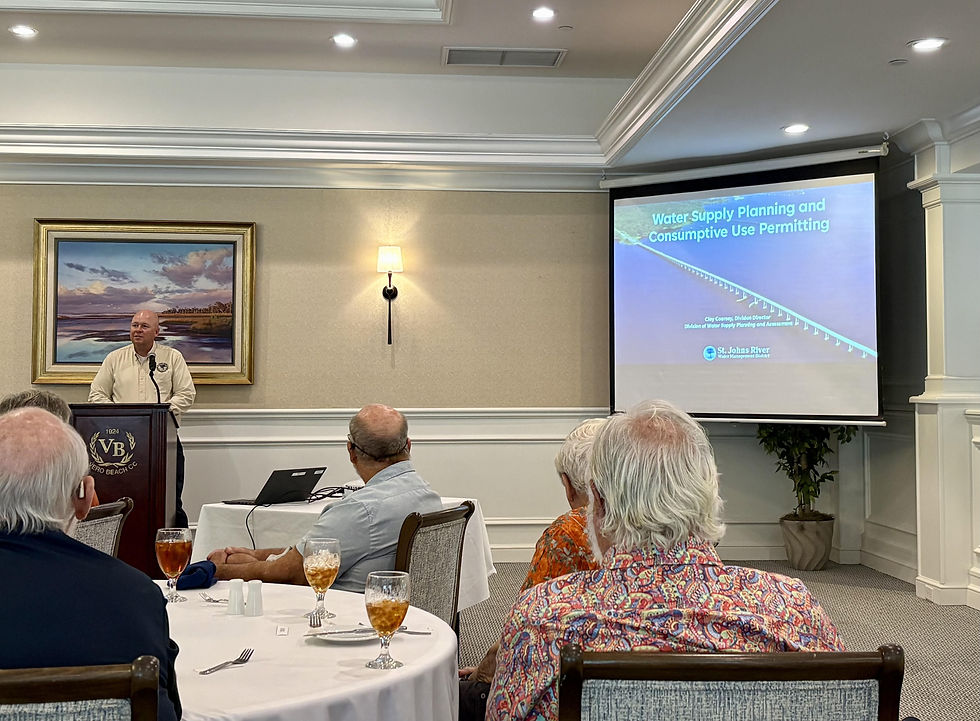
Successful Lunch on Water Supply
Where does Florida's water come from, and will there be enough to sustain our communities, agriculture, and environment in the years ahead? These questions are becoming increasingly urgent here in Indian River County. With much of the region experiencing below-average rainfall and declining groundwater levels, the need to better understand and manage our water resources has never been clearer. At IRNA's March Lunch & Learn, Clay Coarsey of the St. Johns River Water Management District provided valuable insight into where Florida's water originates, how it is used, and what strategies are being developed to ensure a sustainable future.
We're grateful to everyone who joined us for this timely presentation. Your engagement reflects the community's commitment to protecting our water resources -- and to IRNA. A special thank you to Clay for sharing his expertise and helping shed light on the challenges and opportunities ahead. Conversations like these are essential as we work together to safeguard our groundwater, support responsible growth, and preserve the health of our local environment for generations to come.

Florida city has hibiscus history. See Vero Beach past, future ideas (TCPalm) - Reader responses to a recent Reisman column highlight a strong community interest in revitalizing downtown Vero Beach, with suggestions ranging from cosmetic upgrades to major projects like the restoration of the Florida Theatre and addressing traffic congestion at key intersections.
Signs keep our iconic citrus legacy alive (Vero News) - Vero Beach is preserving its agricultural heritage by installing decorative metal signs featuring historic citrus crate labels at various locations as part of the Indian River County Citrus Crate Label Trail.
Indian River Mall: When will renovations happen? (Vero News) - The Indian River Mall redevelopment project is currently undergoing a routine county review process as developers plan to transform the struggling facility into a hybrid shopping center featuring a mix of open-air retail, a central green space, and a drive-thru restaurant.
City, developer negotiating on Three Corners (Vero News) - Vero Beach has officially initiated negotiations with a development team composed of Clearpath Services and Madison Marquette to transform a 38-acre riverfront site into a mixed-use district following the receipt of a long-awaited good-faith deposit.
Indian River approves youth internship partnership (Hometown News) - The Indian River County Commission unanimously approved a youth internship partnership with CareerSource Research Coast to provide disadvantaged young adults with paid job-shadowing opportunities and career training within local government departments.

IRNA's Water and Lagoon Committee Gets Down to Business
If you've ever wondered what it looks like when a room full of people who genuinely care about clean water sit down together for a couple of hours, the Indian River Neighborhood Association's Water and Lagoon Committee can show you.
The committee held a productive working meeting recently, bringing together members, board representatives, and partners to dig into some of the big-picture water issues facing Indian River County. With IRNA's new Chief Science Officer Missy Weiss helping Committee Co-Chair Bob Jones to facilitate, the group covered a lot of ground.
The centerpiece of the meeting was a review of draft position statements the committee has been developing on four key topics: water supply diversification, turfgrass and Florida-friendly landscaping, stormwater management, and septic-to-sewer conversion. These are meant to give IRNA a clear, evidence-based voice when advocating on issues we're likely to be asked about by the public, elected officials, and media. The group worked through each one, offering edits, adding nuance, and debating what we actually believe versus what we just assume.
The conversations were lively. Water conservation (how we use it, waste it, and plan for future demand) generated real discussion, from the mechanics of how municipalities flush water mains to the practical challenges of getting homeowners to rethink their irrigation habits. Stormwater management emerged as a particularly compelling priority, with the committee exploring how better land use, retention, and regional partnerships could help slow the flow of pollutants into the lagoon before they ever get there.
The septic-to-sewer conversation had them reflecting on hard-won progress in recent years and identifying where more work remains, particularly in unincorporated areas of the county where the infrastructure gap is widest.
Homework was assigned. Members will review and annotate the draft position statements with the goal of finalizing them for official IRNA adoption. The committee also discussed inviting additional experts to future meetings to help ground the work in the best available science and local knowledge.
It was, in short, exactly what a working committee meeting should be: focused, frank, and forward-looking. More to come.
If you are interested in joining us or learning more, reply to this email or reach out to Missy at Missy@IndianRiverNA.com.
Ever-growing ‘Gardenfest’ draws 20,000 enthusiasts (Vero News) - Gardenfest 2026 attracted approximately 20,000 attendees to Riverside Park for a two-day botanical marketplace that supports scholarships and local civic beautification projects despite recent frost damage to nursery stock.
Endangered Species Coalition Teams Up With Save The Manatee Club To Protect Manatees (DeeperBlue.com) - The Endangered Species Coalition and the Save the Manatee Club have joined forces to protect the Florida manatee through habitat conservation and public awareness initiatives supported by the Endangered Species Act.
The DeSantis decisions: A Friday afternoon favor for the Fontainebleau (Jason Garcia) - Governor Ron DeSantis signed a wide-ranging land-use bill that includes a specific provision allowing a major donor to bypass local boards to construct a waterpark at the Fontainebleau Hotel in Miami Beach.
Industry leaders urge DeSantis to veto billionaire-backed insurance bill (Jason Garcia) - Insurance industry leaders and trade groups are urging Governor Ron DeSantis to veto a bill that would force condominium associations to accept potentially more expensive private insurance offers over state-backed coverage while allegedly creating a conflict of interest by allowing a major political donor's firm to administer the program.
U.S. Cities that are facing a potential loss of municipal water (Coyote Gulch) - Twenty American cities are facing critical municipal water shortages driven by a combination of dwindling natural sources, rising sea levels causing saltwater intrusion, and failing infrastructure.


Comments