
Bioblitz a Success, Eliminating Property Taxes, and more!

May 2, 2026 Weekly Newsletter

The Indian River County BioBlitz brought the community together for a week of exploration, discovery, and environmental stewardship from April 19–25. Residents, students, and local organizations participated in guided walks and independent outings across a variety of habitats, documenting the rich biodiversity that makes the region so unique. From waterfront trails and coastal beaches to preserves and neighborhood backyards, participants of all experience levels contributed valuable observations.
Using a simple tool like the iNaturalist app, an estimated 132 students and 50 adults recorded nearly 1,500 observations over the course of the week. These efforts resulted in the identification of 533 unique species, highlighting the incredible diversity of life found throughout Indian River County. Observations ranged from native plants and insects to birds, mammals, and reptiles, providing a meaningful snapshot of local ecosystems.
Beyond the numbers, the BioBlitz fostered a deeper connection between people and the natural world. It offered an opportunity to learn from local experts, engage with community partners, and inspire ongoing conservation efforts. The data collected will help inform future environmental initiatives while encouraging continued community involvement in protecting the land and water that sustain Indian River County.
Thank you to everyone who participated and contributed to the success of this year’s BioBlitz. We look forward to seeing you at future Indian River County BioBlitz events!
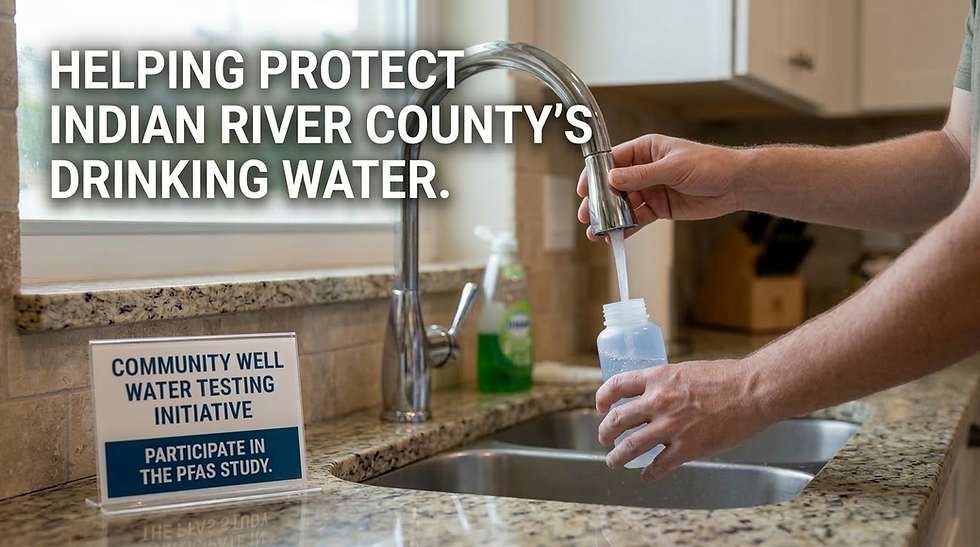
PFAS Well Water Testing
IRNA is offering free, certified lab testing for PFAS ("forever chemicals") in private drinking water wells. Sign up, submit your water sample, and get your results, plus learn what they mean for your health.
We are especially searching for wells at or near Blue Cypress Lake, Fellsmere, Gifford, and Wabasso.
Open to Indian River County home and business owners on private wells only (not connected to municipal water). Questions? Contact Missy@IndianRiverNA.com
New here? If this was forwarded to you, we'd love to have you join our community! Click here to sign up and receive our newsletter weekly.
Stand with the IRNA and help us amplify our community's voice. Your support fuels the fight to protect our natural resources, hold elected officials accountable, and drive the real change our neighborhoods deserve. Together, we don't just speak up, we make an impact that lasts.

How Does Indian River County Grow
Without Losing What Makes It Worth Living Here?
Growth is coming to Indian River County. That much isn't up for debate. The question worth asking (and the one too few people are asking) is what that growth actually looks like when it arrives.
Do we keep pushing outward, stretching infrastructure thinner and eating up the land and water resources that define this place? Do we look toward density and infill which makes some residents uneasy? Or is there a middle path that nobody's found yet because we haven't had the right conversation?
That's what we're digging into at IRNA's May 27 Lunch and Learn, and we've brought in someone who can actually speak to the mechanics of how these decisions get made.
Thomas Lanahan is the Executive Director of the Treasure Coast Regional Planning Council, and he's spent decades working in and around local planning and state-level growth mandates. His perspective is what you might call "high altitude" (he sees the patterns across the region, not just the project-by-project fights that tend to dominate local meetings). He knows where the pressure points are, what tools local governments actually have, and where those tools fall short.
If you've been following the Urban Services Boundary debate, you already know the stakes. Annexation proposals keep surfacing. Development pressures aren't slowing down. And the decisions being made right now will shape this county for decades. The challenge is that most of those decisions happen in increments (a rezoning here, an annexation there) without much public discussion of the bigger picture.
This conversation is a chance to zoom out. To talk about suburban sprawl and urban density not as abstractions, but as choices with real consequences for our roads, our water, our lagoon, and the character of the communities we live in.
May 27 | Noon | IG Center at 1590 Oslo Rd, Vero Beach, FL 32962 | $25/pp
Seating is limited.

John’s Island salutes new water supply as praise pours in for an inspired idea (Vero News) - A new $13.5-million civil engineering project in Vero Beach diverts polluted canal water to the John’s Island community for irrigation, protecting the Indian River Lagoon from nitrogen runoff while preserving the local drinking water aquifer.
Fellsmere to get first surf park with artificial wave pool in Florida (Sebastian Daily) - The Point Surf Park is under construction in Fellsmere and is set to open in 2026 as Florida's first surf park, featuring a $30 million artificial wave pool powered by air-pressure technology to provide year-round, customizable waves for all skill levels.
Huge Florida development by Buc-ees may threaten rural character (TCPalm) - St. Lucie County commissioners have expressed concerns that Lennar Homes' proposed Indrio Groves development, a mixed-use project featuring over 3,000 housing units, could trigger urban sprawl and threaten the rural character of the northern part of the county.
Florida sea turtle eggs moved for beach sand restoration projects (TCPalm) - Beach monitoring teams have relocated more than 4,100 sea turtle eggs from Treasure Coast beaches to protected sites to prevent their destruction by heavy machinery used in ongoing sand restoration and erosion control projects.

The Tax Cut That Could Break Your City:
What the "Let's Talk Vero" Forum Revealed
The April 9 "Let's Talk Vero" forum focused on the proposed constitutional amendment that, if passed by 60% of voters this November, would eliminate non-school property taxes for homesteaded residents beginning January 1, 2027. On the surface, it sounds like a gift. Underneath, the panelists made clear, it's something much more complicated.
What's Actually on the Table
Let's start with what this proposal is (and isn't). The Florida House passed HJR 203 by an 80–30 vote in February, advancing the idea of a full elimination of non-school property taxes for homesteaded properties. The measure then died in the Senate when it was never heard in the Appropriations Committee before the regular session ended on March 13. Legislative leadership has since removed property tax reform from the agenda for the special session beginning April 28, pushing any further action to a potential session in late May or June. If the proposal is eventually revived and placed on the November ballot, voters would need to clear a 60% supermajority threshold to make it law.
But calling it a "tax cut" is generous. As Lance Lunceford of the Taxpayers Association of Indian River County put it bluntly, this isn't a cut. It's a shift. The costs of running local government don't disappear just because one group of taxpayers stops paying. Those costs get pushed somewhere else (onto businesses, onto renters, onto the people least equipped to absorb them).
In Indian River County, total property taxes currently represent only about 0.9% of market value (roughly 1.5% of taxable assessed value). It's not nothing, but it's also not the crisis driver that many residents assume it is. The panelists were nearly unanimous in that runaway homeowners insurance costs, not property taxes, are the true engine of Florida's affordability problem.
The Local Math
The numbers laid out at the forum were stark.
Vero Beach City Manager Monte Falls explained that property taxes fund the city's General Fund, which covers the Police Department, Public Works, parks, planning, recreation, and lifeguards. The city collects about $14 million in property taxes annually. That figure, Falls noted, roughly equals the city's entire police budget. A January 1 implementation date would leave zero planning time for cities to restructure.
Mayor John Cotugno put the labor reality into focus: 80% of Vero Beach's general fund goes to labor and benefit expenses. Cutting the budget significantly doesn't mean trimming around the edges. It means cutting people.
Zooming out to the county level, County Commission Chairman Daryl Loar broke down the broader picture. Total county property tax revenue sits at roughly $468 million. About $200 million of that goes to the school system and would likely remain untouched by this proposal. But the remaining $268 million funds everything else (fire rescue, infrastructure, libraries, the sheriff's office, all of it). Indian River County faces an estimated $125 million revenue shortfall if the amendment passes.
Loar also raised the affordable housing issue that often gets left out of these conversations. Landlords will pass increased commercial property taxes on to tenants. That, he said, would "effectively end the argument" for affordable housing in the region. He described the county budget as a "moral contract" between government and community, one that funds the infrastructure residents depend on daily.
What Tallahassee Is (and Isn't) Doing
Representative Robbie Brackett (District 34), a former mayor himself, was recorded as not voting on the House's final 80–30 roll call for HJR 203.
Over in the Senate, Senator Erin Grall (District 29) has been part of the leadership expressing real skepticism about the House's approach. Grall and her colleagues have signaled a preference for a more measured alternative: expanding the homestead exemption (from $50,000 to $100,000, for example) rather than eliminating non-school property taxes entirely. That approach would still deliver meaningful relief to homeowners while preserving a more stable revenue base, particularly for what the Senate calls "fiscally constrained" counties.
Grall has also received formal requests from local municipalities (including the Town of Orchid) warning that the House plan could lead to the outright dissolution of some small local governments. That's not hyperbole. For a tiny municipality with a narrow tax base, losing homestead property tax revenue could make it mathematically impossible to operate.
The Home Rule Question
Mayor Cotugno raised a point that always deserves more attention: home rule. Local government, he argued, is where citizens have the most direct influence. It's where you can show up to a meeting, look your elected official in the eye, and be heard. Shifting the funding mechanism (and by extension, the power) to Tallahassee makes government less responsive to local needs, not more.
This a big cost of the proposal that doesn't show up in the revenue projections. When local governments lose the ability to fund their own services, they lose the ability to set their own priorities. Decisions about your neighborhood's parks, your city's police staffing, your county's road maintenance increasingly get made by people who have never driven on those roads.
Where Things Stand
Recent polling shows Florida voters nearly split on the proposal (47% in favor, 53% against). With a 60% supermajority required for passage, the math is currently steep for proponents. And with property tax reform now pulled from the April 28 special session agenda, the proposal's path to the November ballot has grown even more uncertain. A potential late May or June session may revive the discussion, but for now, the issue is in limbo.
The panelists' advice to the community was clear and consistent: stay engaged, contact your state representatives, and look past the appealing simplicity of a "no more property taxes" headline. The question is whether you're prepared for what happens to your city, your county, and your neighbors when that revenue disappears and the bills come due anyway.
The Dirty Money Project Is Getting Bigger — And We Need Your Help (VoteWater.org) - VoteWater is expanding its Dirty Money Project for the 2026 election cycle by launching an enhanced database and investigative reporting series designed to track campaign contributions from industrial interests and expose their influence on South Florida's environmental policies
Water reuse is essential for economic growth, the EPA says. Experts see obstacles ahead. (Smart Cities Dive) - The Environmental Protection Agency's new WRAP 2.0 initiative positions water recycling as a vital component for industrial growth and infrastructure, though its success may be hindered by inconsistent state regulations, funding limitations, and public concerns regarding treated wastewater.
Way down upon this Florida river, pollution and water withdrawals spell double trouble (Florida Phoenix) - The Suwannee River has been designated as one of the nation's ten most endangered rivers due to a combination of excessive aquifer withdrawals that have dried up historic springs and significant nitrate pollution from dairy farm runoff.
Fort Pierce's new North Causeway Bridge spans across Indian River Lagoon (TCPalm) - The Florida Department of Transportation is replacing the structurally deficient D.H. 'Banty' Saunders drawbridge with a new $111.5 million fixed span over the Indian River Lagoon that will become the tallest bridge on the Treasure Coast upon its completion in late 2027.


Comments