
Treating Symptoms vs a Cure, Biosolids Veto, and more!

July 11, 2026 Weekly Newsletter
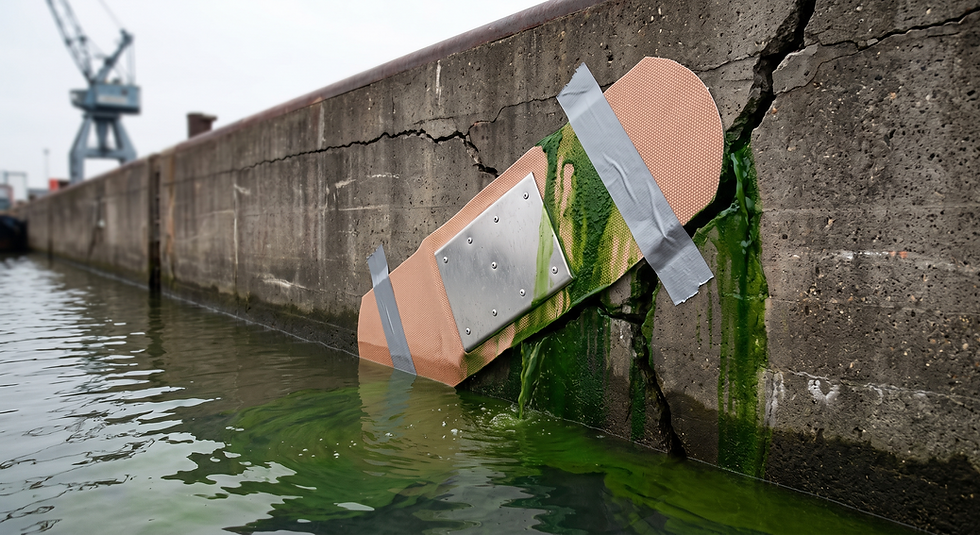
We Keep Treating Symptoms
There is a photograph that Florida politicians love. A barge in the lagoon, a plume of muck rising through the pipe, a ribbon cutting, a check the size of a door. It looks like the problem being solved. Usually it's the problem being moved.
We have spent a decade and hundreds of millions of dollars on machines that make the Indian River Lagoon briefly cleaner without making it any less sick. We dredge the black muck off the bottom. We dose the water with phosphorus-binding clays. We float and skim algae. We run aerators to push oxygen where the sediment has strangled it. Every one of these does something. Not one of them stops the nitrogen and phosphorus still pouring in from septic tanks, fertilizer, and stormwater runoff. They move the pollution around. They park it on the bottom. And the next big storm hands it right back.
We know this because the people doing the work say so. Florida Tech's John Trefry, who supports dredging what's there and has studied lagoon muck longer than almost anyone, put it plainly: dredge it, but if you don't cut the upland runoff, the muck comes right back. After Hurricane Matthew, researchers watched that muck resuspend and redistribute across the lagoon floor, nutrient fluxes spiking in the very sediment dredging had left behind. An aeration experiment in a lagoon canal changed the dissolved oxygen and changed nothing about the muck itself, then got overrun by a brown-tide bloom mid-trial. The chemistry is no better. Alum and lanthanum clay bind phosphorus beautifully in the lab and in the brochure, but a widely cited long-term study of an alum program found most of the treated lakes failed within twenty-five years, because nobody cut what was flowing in. And none of it touches nitrogen, which is what actually drives many of our issues.
So why do we keep buying the barge? Because the barge is visible. It is fundable. It photographs well. A septic-to-sewer conversion three streets back from the water is none of those things. Nobody cuts a ribbon over an enforced fertilizer ordinance. The upstream work is slow, buried, unglamorous, and it is the only thing that actually lowers the load.
The good news is that some of our neighbors have already done the math out loud. Brevard County's Save Our Indian River Lagoon program publishes what each fix costs per pound of nitrogen removed, and over its first decade it quietly moved its money out of muck dredging (two-thirds of the plan at the start, closer to a quarter now) and into septic-to-sewer and stormwater. That is the shift. That is what treating the cause looks like on a budget line.
The Indian River Lagoon National Estuary Program (One Lagoon) has been pointing us this direction for years, with a science-based plan that puts wastewater, stormwater, and impaired waters at the top. Groups like ORCA, the Marine Resources Council, and the Indian Riverkeeper keep the receipts. And this is the work IRNA fights for, the basis of our concerns about annexations, ordinances, and the growth decisions where the load is actually won or lost.
We need to stop treating symptoms. The lagoon has been telling us this for a long time. We should listen.
PFAS Well Water Testing
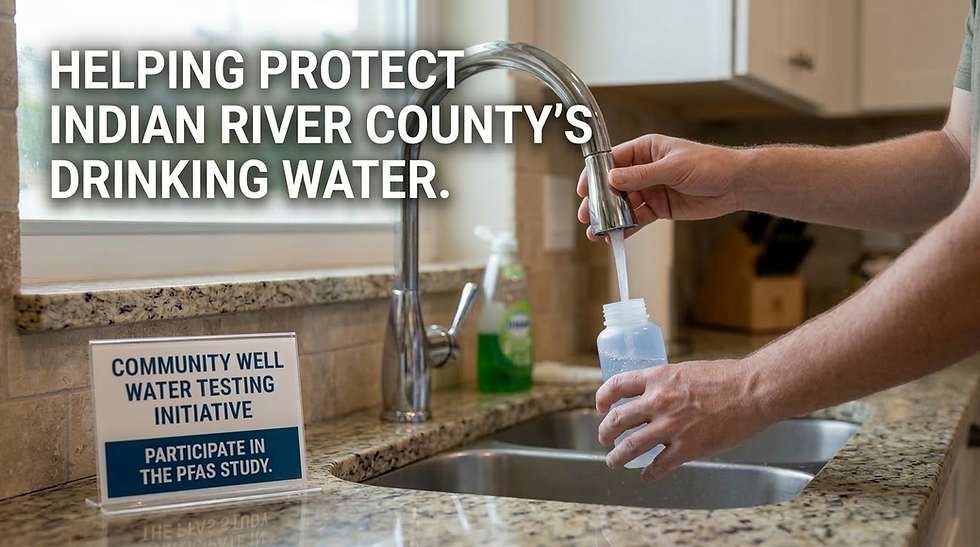
IRNA is offering free, certified lab testing for PFAS ("forever chemicals") in private drinking water wells. Sign up, submit your water sample, and get your results, plus learn what they mean for your health.
We are especially searching for wells at or near Blue Cypress Lake, Fellsmere, Gifford, and Wabasso.
Open to Indian River County home and business owners on private wells only (not connected to municipal water). Questions? Contact Missy@IndianRiverNA.com
New here? If this was forwarded to you, we'd love to have you join our community! Click here to sign up and receive our newsletter weekly.
Stand with the IRNA and help us amplify our community's voice. Your support fuels the fight to protect our natural resources, hold elected officials accountable, and drive the real change our neighborhoods deserve. Together, we don't just speak up, we make an impact that lasts.

A Step Not Taken:
Why the Biosolids Veto
Was a Missed Opportunity
When Governor DeSantis vetoed House Bill 1245 on June 30, he struck down something rare in today's politics: a bill that everyone agreed on. Both chambers of the Florida Legislature passed the Biosolids Management Bill unanimously (111-0 in the House, 38-0 in the Senate), with Republicans and Democrats alike recognizing that something needed to be done about the way treated sewage sludge gets spread across Florida's farmland. That kind of consensus doesn't happen by accident, and it doesn't happen often. Setting it aside deserves a closer look.
Nobody is claiming HB 1245 was flawless. The Governor raised a few points that reasonable people can take seriously. The five-year recordkeeping requirement would have added real paperwork for farmers and landowners. The provision leaning on a private trade group's certification program (the U.S. Composting Council's Seal of Testing Assurance) was an awkward fit, handing a slice of state oversight to a fee-collecting outside entity. These are fair concerns, and honestly, they're the kind of thing you fix in a committee markup, not the kind of thing you kill an entire bill over.
Because here's what the veto also swept away: a genuine, science-based attempt to keep Florida's waterways from drowning in nutrients. The heart of the bill was simple and sensible. It said you can't dump nutrient-dense human waste on farmland faster than crops can actually absorb it. It asked the University of Florida's agricultural experts (not waste haulers looking to cut costs) to set those application rates. And it drew a bright line between genuinely reusing biosolids as fertilizer and just discarding waste on a field and calling it farming.
That line matters more than ever right now. Florida is already set to ban lower-grade Class B biosolids statewide in 2028, which sounds like a win (and in some ways it is). But the waste doesn't disappear. Municipalities are investing heavily in "up-treating" that same sludge into Class AA biosolids, which historically face almost no limits on how much you can spread. HB 1245 was designed to close exactly that loophole before it opened. Without it, the 2028 ban risks becoming a relabeling exercise: the same trucks, the same pastures, the same vulnerable stretches of the St. Johns River, just a new name on the paperwork.
This is why incremental progress deserves more respect than it usually gets. Waiting for the perfect, comprehensive, everyone-gets-everything bill is a good way to get nothing at all. HB 1245 wouldn't have solved every problem. It said little about the looming PFAS "forever chemicals" crisis, and its enforcement mechanisms could have been stronger. But it would have established the core principle (that biosolids are a resource to be managed carefully, not a liability to be dumped) into state law. Principles like that are foundations. You build on them. Once the agronomic-rate standard exists in statute, next year's Legislature isn't starting from zero. They're refining, extending, adding the PFAS provisions, tightening the recordkeeping so it's less burdensome but still meaningful. Progress compounds. A step forward, even a modest one, changes where the next step begins.
And that's the real reason for hope. The coalition that pushed this bill through didn't vanish on June 30. The St. Johns Riverkeeper, 1000 Friends of Florida, the Florida Springs Council, Audubon Florida, and the bipartisan legislators who voted yes are all still here, and now they have something they didn't have before: a fully drafted, fully vetted bill and a detailed veto message spelling out precisely what the Governor's objections were. That's a roadmap. Strip out the third-party certification language, streamline the recordkeeping so it targets only what regulators actually need, and you've addressed the stated concerns while keeping the environmental heart of the bill intact.
The unanimous votes prove the underlying support is real and durable. The 2028 deadline guarantees the issue isn't going away. And the growing national reckoning over PFAS contamination (from the farms of Maine to the lawsuits in Texas) means the pressure to act will only build. A veto can delay a good idea. It rarely kills one whose time has clearly come.
Next session, the Legislature can bring this back stronger, cleaner, and harder to refuse. The groundwork is laid. The consensus exists. Sometimes a setback is just the draft before the version that finally sticks.

Here's how Buc-ee's, homes can change St Lucie, Sebastian | Opinion (TCPalm) - Laurence Reisman argues that rapid, profit-driven development is irreparably destroying Florida's natural habitats and agricultural heritage, urging citizens to actively support local conservation efforts before the state's remaining wildlife and peaceful green spaces are lost forever.
County hits pause on $5.5M pact for conservation parcel (Vero News) - Indian River County commissioners voted to delay signing a 5.5 million dollar conservation land purchase contract until receiving a formal guarantee that an environmental group will reimburse half of the cost.
County releases 2026-27 Fiscal Year budget (indianriverguardian.com) - Indian River County has released its proposed 614.8 million dollar budget for the 2026-2027 fiscal year, which maintains current millage rates for the seventh consecutive year while balancing rising operational costs, state-mandated funding increases, and public safety priorities.
County steps in to avert GoLine funding ‘crisis’ (Vero News) - The Indian River County Commission unanimously approved 263,000 dollars in emergency gap funding for the Senior Resource Association to cover a severe budget deficit caused by rising fuel and maintenance costs for its local public transit system.
Sebastian Pines land use headed to state (hometownnewstc.com) - The Sebastian City Council unanimously approved residential zoning for the 204.42-acre Sebastian Pines development and transmitted a land-use amendment request to the Florida Department of Commerce, moving the 502-unit project forward despite local resident concerns regarding increased density and traffic.
Indian River County Commission District 2 candidates seek election (TCPalm) - Four candidates running for the open Indian River County Commission District 2 seat detailed their qualifications, professional accomplishments, and policy priorities regarding fiscal responsibility, local infrastructure, public safety, and environmental protection in a comprehensive election questionnaire.

DEP Announces $230 Million in Grant Funding for FY 2026-27
The Florida Department of Environmental Protection (DEP) has announced more than $230 million in grant funding opportunities for the coming fiscal year, with proposals accepted from July 1 through September 1, 2026.
Several of these programs are directly relevant to our region. The Indian River Lagoon Water Quality Improvement Grants offer funding for wastewater upgrades (including septic-to-sewer conversions), stormwater, and agricultural projects that reduce nutrient pollution.
Additional opportunities include Alternative Water Supply Grants, Springs Restoration Grants, Nonpoint Source Management Grants, and funding for innovative approaches to harmful algal blooms. On the coastal side, DEP is also offering Resilient Florida Implementation Grants and Beach Management Funding Assistance for local governments.
We would love to see our cities and county pursue these dollars. Every grant captured locally means real progress for the Lagoon and stronger protection for the water resources our community depends on. We encourage our municipal and county leaders to take a close look at what's available and put together strong proposals before the September deadline.
Details and proposal forms are available at ProtectingFloridaTogether.gov/Grants, with a full list of opportunities at FloridaDEP.gov/Funding.
Vero Beach hosts time capsule ceremony for America’s 250th anniversary (hometownnewstc.com) - Local leaders and residents in Vero Beach gathered to bury a community time capsule that will remain sealed until 2076 to commemorate America's 250th anniversary.
Florida drawbridge turned into reef. Find out where it will be sunk (TCPalm) - The remains of the demolished North Causeway Bridge in Fort Pierce will be deployed as an artificial reef six miles off the coast of Florida to expand marine habitats and attract local marine life and divers.
How Do You Get Americans to Use Less Water? (U.S. News) - Local authorities across drought-stricken American communities are navigating the politics of scarcity by choosing between civic appeals and strict, fine-backed rationing mandates to curb surging residential and industrial water consumption.
Behind the Cause: 10 Years in Review with Captains for Clean Water (flylordsmag.com) - Captains for Clean Water has spent ten years building a diverse coalition to advocate for restoring the natural southward flow of freshwater through the Everglades to protect South Florida's marine ecosystems, economies, and public health from toxic discharges.
DeSantis vetoed $15M in Treasure Coast projects. Here's what died. (TCPalm) - Florida Governor Ron DeSantis vetoed 15 million dollars in funding across 11 Treasure Coast public safety, infrastructure, and healthcare projects as part of his final line-item state budget cuts.


Comments